Artificial intelligence is fundamentally changing enterprise software. In ERP systems in particular, AI agents can increasingly take over repetitive transactions and standardised processes, such as data entry, reconciliation and administrative workflows.
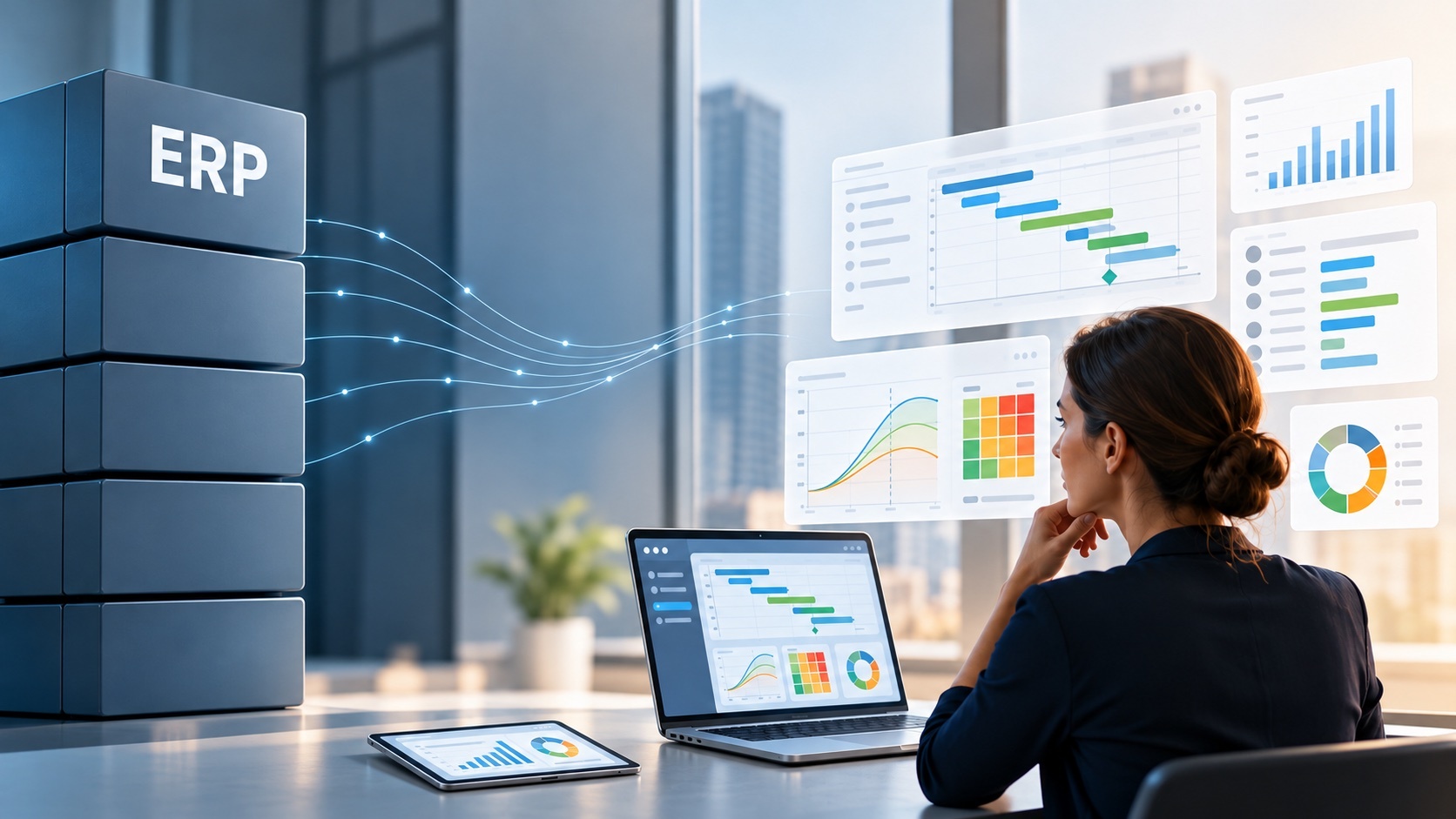
The crucial distinction is that ERP automates transactions, while simulation software such as Can Do assesses how changes affect projects, resources and capacity, supporting decisions.
This capability matters increasingly in complex project organisations. When priorities, dates or resources change, executing processes faster is not enough. Businesses need to understand the consequences of a decision for the entire portfolio.
The value of enterprise software is shifting towards systems that identify relationships, simulate scenarios and evaluate options, alongside recording and processing data.
The following discussion draws on the future technology scenarios and architectural analysis in Can Do's technical paper on the development of AI, agents and enterprise software.
Why Can Do works differently
Can Do is built around a simulation system for projects, resources and capacity. Its architecture differs from that of a conventional transaction or administration system.
An ERP system might process a posting, an amount or a status. Can Do continually assesses how changes affect a complex project environment.
If a key resource's availability changes, Can Do calculates the possible consequences for other projects, dates, capacity, risks and dependencies.
This is the technological distinction:
ERP systems primarily process transactions and structured workflows.
Can Do models relationships between projects, resources, skills, capacity and risks.
Changes are assessed for their effects as well as stored.
Different scenarios can be explored before a decision is made.
This architecture becomes especially relevant when combined with AI. An AI agent can analyse information and formulate recommendations. For dependable project and resource decisions, however, it needs a system that can calculate the effects of possible actions.
Can Do can therefore serve as a simulation and decision-support core that AI agents may access in future, as well as an interface for planning projects.
What Can Do can already do
The foundation already exists. Can Do connects project, portfolio and resource information in a shared model and continually calculates how changes affect the project environment.
This enables organisations to:
Identify resource bottlenecks early
Make skill and capacity conflicts across projects visible
Assess risks and their possible effects
Account for dependencies between projects and work packages
Simulate what-if scenarios before implementing changes
When a project moves, an important resource becomes unavailable or additional capacity is needed, Can Do calculates the possible consequences for other projects, resources, dates and risks.
It already supports a central question for modern project organisations: “What happens to our portfolio if we make this decision?”
This simulation capability distinguishes Can Do from systems primarily designed to record, administer or visualise project information.
Practical example: a critical skill becomes available four weeks late
Suppose five active projects need the same specialist skill in the coming weeks. A key person assigned to provide it becomes available four weeks later than planned.
A conventional plan initially shows a missing resource. The next question is decisive: what does that delay mean for the entire project environment?
Can Do can calculate which projects are affected and what consequences may follow:
Which work packages cannot start as planned?
Where do new resource or skill conflicts arise?
Which dates come under pressure?
Which dependencies on other projects are affected?
Where does project risk increase?
How is available capacity affected?
Different what-if scenarios can then be explored. What changes if a project moves, another resource is assigned or priorities are adjusted?
A single change becomes a scenario that can be simulated across the portfolio.
What businesses gain
Simulation helps businesses understand complex project environments earlier and manage them with better information.
Earlier risk identification
Bottlenecks, delays and dependencies can be identified and assessed before a project reaches a critical stage.
Better resource decisions
Businesses can see where capacity or skills are missing and how alternative resource decisions affect other projects.
More dependable portfolio planning
New projects, priority changes and delays can be simulated in advance. This shows which decisions are feasible and which would create conflicts.
The central benefit is better preparation for decisions about projects, resources and priorities, alongside greater visibility.
What AI could add in future
AI extends this foundation through analysis, interaction and decision support.
In future, agents could increasingly interpret project information, monitor changes and use simulation results to prepare practical options.
Possible agents could:
Automatically identify resource and project conflicts
Prioritise critical developments
Initiate alternative scenarios
Suggest specific actions
Proactively alert project leaders when a decision is needed
Today's question, “What happens if we change something?”, could increasingly become: “Which option makes most sense under the current conditions?”
AI does not replace the underlying simulation logic. As AI prepares more decisions, a dependable model that calculates effects on resources, dates, risks and dependencies becomes more important.
Over time, simulation and AI agents can work together: Can Do provides the calculation and scenario logic, while AI simplifies access and further automates decision support.
The quiet transformation of enterprise software
Why the main AI transformation goes beyond the chat window
AI affects software categories differently. Some systems become heavily automated, while others gain strategic importance because of AI.
ERP vendors face the prospect of becoming less visible
ERP systems are unlikely to disappear suddenly. Instead, direct interaction with them may gradually decline.
As AI agents automate more operational processes, people use conventional ERP interfaces less often. The software remains, but moves into the background.
Why AI particularly affects conventional ERP systems
Why repetitive ERP processes lend themselves to automation
An AI agent in an ERP system is autonomous software that analyses information, interprets rules and derives process steps from them.
The more a process is digital, repeatable, governed by clear rules and requires little interpretation, the easier it is to automate.
Traditional ERP processes often meet these conditions. AI agents could therefore take over substantial parts of operational administration over the medium term, including invoice checks, approvals, master data maintenance, document reconciliation and straightforward posting logic.
Why ERP systems will remain
The role of ERP changes. It continues to provide the organisation's financial data core, rules, transaction foundation, documentation and governance structure.
What may decline is the layer of direct human interaction. Staff may spend less time working through forms and checking routine cases manually, while agents handle more operational workflows in the background.
Why project management follows different rules
Projects involve uncertainty and change
Project management presents a more complex situation. This creates a distinction between conventional ERP systems and simulation-based project management platforms such as Can Do.
The structural difference between ERP and Can Do
The comparison illustrates why AI is likely to transform these software categories in different ways and at different speeds.
How AI and agents could transform enterprise software
The original comparison presents a possible development scenario. Its dates are indicative, not product commitments or a guaranteed forecast.
ERP and Can Do compared at two levels
Area
Today
In 1–3 years
From 2030
From 2033
ERP: use and processes
Administrative staff; manual entry; recurring routine tasks; interfaces, forms and modules.
Agents handle standard cases; less manual administration; coordination of several agents; interface use declines.
Many application tasks disappear; individual modules disappear; agents directly control processes.
Administration is largely automated; company-wide agent networks; people focus on strategy, creativity and exceptions.
ERP: core, data and calculation
Data, rules and transaction core; financial accounting, procurement and order management; reports and postings.
ERP remains the core and data source, providing rules, postings and traceability.
An increasingly invisible background core; microservices, deterministic methods, transactions and storage.
Project and line managers and stakeholders; manual analysis and communication; status enquiries; assessment of risks and actions.
Agent support: monitor active projects, request information from staff and prepare solutions; significant potential time savings.
AI plans similar projects largely independently; derives plans from requirements and specifications; AI and Can Do support staffing; people provide expertise, leadership and communication.
A possible company-wide superintelligence; coordinated project environments; autonomous planning and tracking; people provide vision, accountability and relationships.
Can Do: simulation core
Real-time simulation for projects, resources and capacity; budgets, dates and risks; planning with uncertain data.
Simulation and data core; real-time calculation, risk analysis and tracking.
Central simulation core accessed by agents; licensing may shift towards usage rather than direct operation.
AI-supported background simulation core; real-time simulation for agent networks; a partly visible interface; simulation and agent services.
ERP: Earlier, substantial transformation from interface and module providers towards data, rules, microservices and agent platforms.
Can Do: A potentially later and deeper transformation through company-wide AI integration and agent control. The simulation core remains important while direct human interface use declines.
Shared direction: Core systems remain; interfaces become less visible. The original scenario considers company-wide superintelligence from 2033 as a possibility.
Real-time simulation becomes a strategic advantage
Why conventional planning is no longer enough
The central question is changing from “What does our plan look like?” to “How does each change affect the whole system?” This makes real-time simulation strategically important.
In enterprise environments, organisational complexity is growing faster than people's ability to manage it manually. This is particularly evident in mechanical engineering, plant engineering, engineering services, IT, product development and other project-driven organisations.
Learn more about resource planning with Can Do.
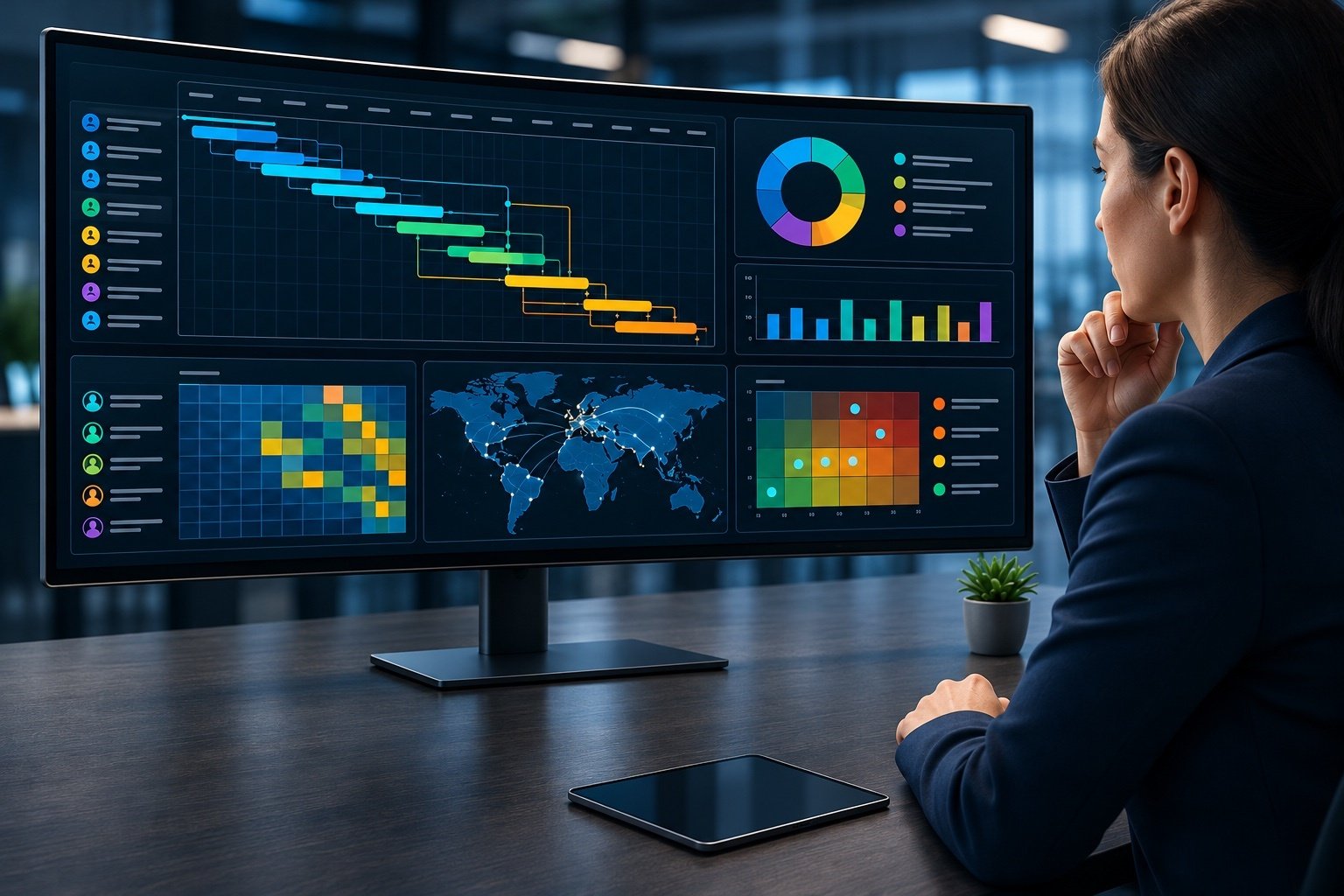
Illustrative dashboard.
How AI changes the project manager's role
A shift in responsibilities
Debate about AI often focuses on which jobs will be replaced. In project management, the more likely initial development is a shift in responsibilities.
Agents could take over operational activities such as monitoring, status enquiries, follow-up, risk identification and analysis, changing the project manager's role.
Why human interpretation becomes more important
As operational analysis becomes automated, communication, prioritisation, stakeholder management and strategic judgement gain importance.
Human strengths increasingly lie in interpreting situations and providing direction. Project management becomes less administrative while also becoming more demanding.
Why conventional interfaces may become less prominent
Asking software questions
Most enterprise systems were designed for people to operate directly through forms, menus, tables, dashboards and Gantt charts. That approach is beginning to change. Project leaders may increasingly use natural language to interact with systems.
Instead of asking where to find a risk analysis, they might ask: “Which projects threaten our capacity next quarter?”
Instead of checking which resources are available, they might ask: “Which staffing option minimises risks and delays?”
The interface becomes conversational. The underlying capability comes from the combination of the data model, simulation logic and AI agents.
The next stage: AI agents
Individual AI features are not enough
A broader transformation could arise from many specialised agents working together.
One identifies risks, another requests status information, a third analyses resource bottlenecks, a fourth simulates responses and another prioritises recommendations.
The challenge increasingly becomes coordinating these agents effectively, rather than improving an individual model alone.
A possible development path for enterprise AI
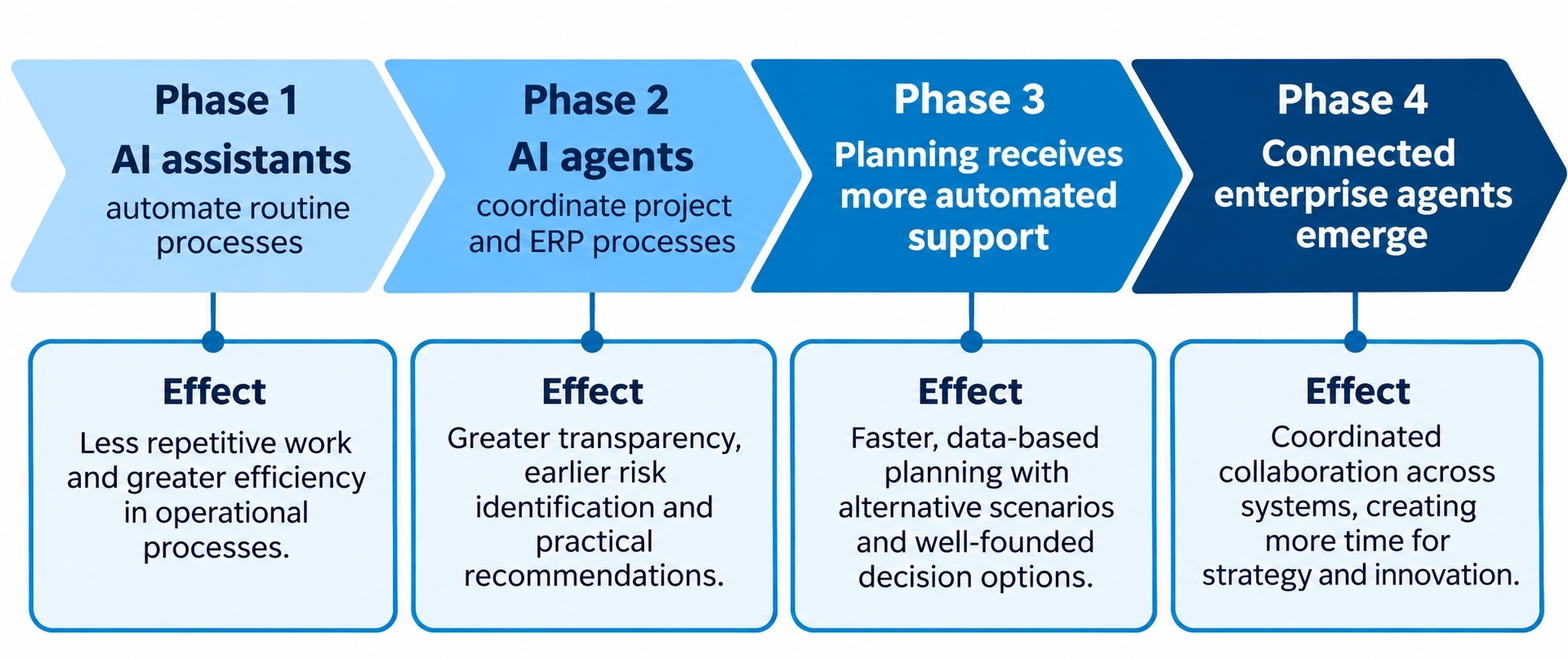
Progress will vary across organisations, industries and software categories. One possible pattern moves from individual assistants to specialised agents and then to more connected decision-support and automation systems.
A possible development path, not a guaranteed timeline. Open the image to view it full size.
Phase 1: assistants automate routine processes
Initially, AI handles repetitive, clearly structured tasks. ERP-related processes such as document processing, approvals, invoice checks, master data maintenance and standard status enquiries are particularly suitable.
People remain responsible while gaining relief from routine administration.
Phase 2: agents coordinate processes
Several specialised agents could then work together to monitor projects continuously, identify and prioritise risks, detect resource bottlenecks, request status information independently and propose actions or alternatives.
In project management, connecting to simulation systems becomes particularly important. An agent can assess recommendations effectively only when their effects on resources, dates, risks and dependencies can be understood.
Phase 3: planning receives more automated support
More capable AI could increasingly support project planning. If requirements documents, technical specifications, historical project data and organisational constraints can be interpreted reliably, systems could generate initial plans, derive resource requirements, forecast risks, develop alternative scenarios and compare planning options.
Over the longer term, organisations could use connected agents to coordinate project planning, resource management, procurement, finance and reporting.
People would manage fewer individual operational steps and focus more on strategy, prioritisation, creativity, innovation and business decisions.
The direction matters more than the timing
The precise timing of each phase is less important than the technological direction. Enterprise software is evolving towards interpreting situations, simulating consequences and actively supporting decisions, as well as storing information and representing processes.
Simulation-based platforms gain importance because agents that plan, assess and propose actions need a dependable simulation core to calculate the consequences.
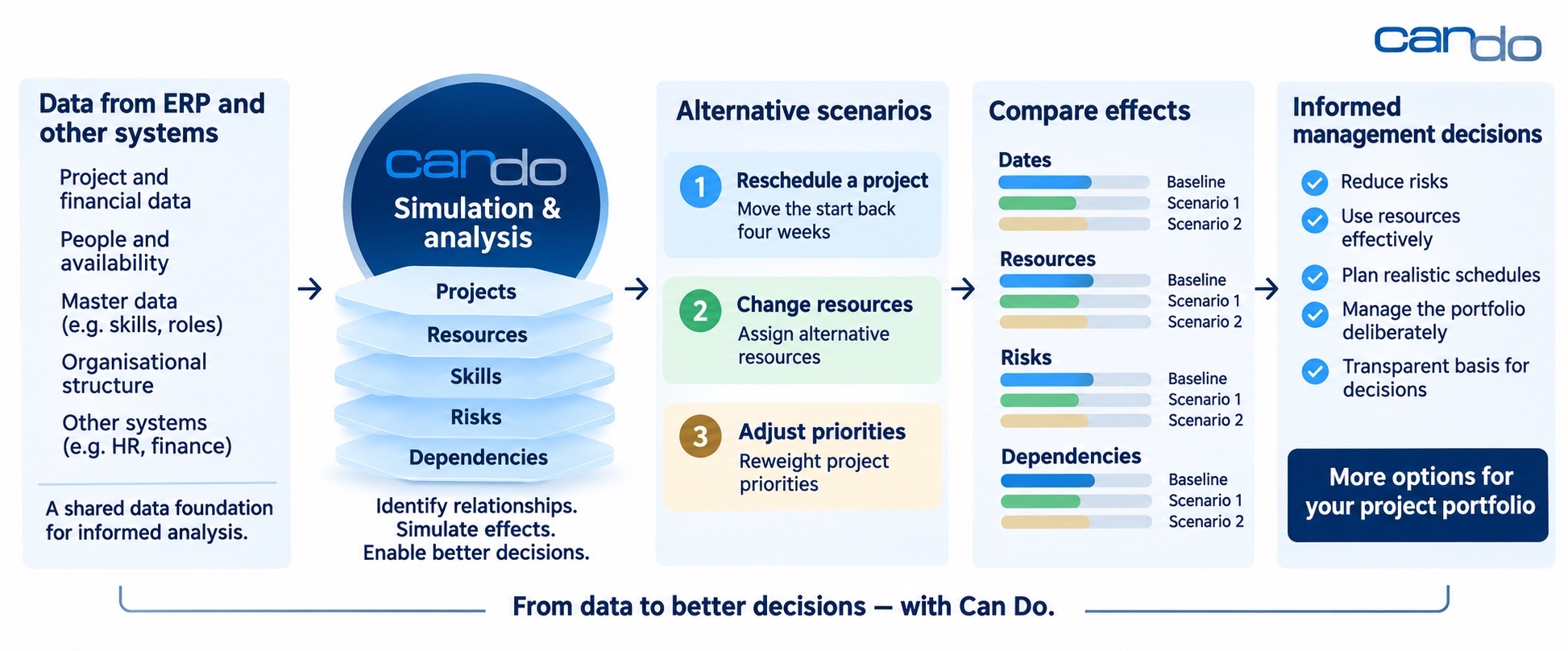
Can Do makes visible how resource and skill conflicts affect multiple projects and which alternative scenarios are possible.
Simulation makes the effects of possible portfolio decisions visible. Open the image to view it full size.
Why European enterprise software may gain strategic importance
AI needs governance, transparency and traceability
Data protection, governance and traceability are central concerns in the enterprise market in Germany, Austria and Switzerland.
Businesses need systems whose outputs can be assessed and whose data remains under control. GDPR compliance, transparent decision logic, European data hosting and enterprise governance therefore become increasingly important.
Simulation-based enterprise systems with a clear architecture could gain strategic relevance as a result.
Conclusion: simulation logic becomes central
The important question is increasingly which systems can model complex relationships, simulate consequences and provide AI agents with reliable information for decisions, rather than which interface employees use.
This is the strategic significance of simulation-based project management software such as Can Do.
Frequently asked questions about AI, project management and ERP
Will AI replace ERP systems?
Transformation is more likely than complete replacement. ERP systems remain the data and transaction core while AI agents take over operational tasks.
Why is project management harder to automate?
Projects involve uncertainty, communication, prioritisation and dynamic change. Many decisions still require expert interpretation.
What is an AI agent in project management?
An AI agent is autonomous software that analyses project information, identifies risks and prepares possible actions.
What role does real-time simulation play?
Real-time simulation helps businesses immediately understand how changes affect resources, dates, risks and budgets.
Which tasks could AI agents take over in future?
Likely tasks include monitoring, status enquiries, risk identification, analysis, suggested priorities and administrative process steps.
AI-supported portfolio, project and resource management
Plan ahead, make decisions based on facts and reduce administrative work.
Can Do: the all-in-one platform for portfolio, project and resource management
Improve project, resource and risk management with Can Do, trusted by leading German businesses:
Automate skill and resource management with advanced AI tools.
Keep track of portfolios and projects with real-time visualisations.
Make better decisions with comprehensive risk assessments and business intelligence.
Can Do is developed in Germany, hosted in German data centres and fully GDPR-compliant.
Learn more about Can Do's AI capabilities.
Book a free demo to see how Can Do simulates resource and project risks.
A short introduction to Can Do provides a two-minute overview of features, benefits and use cases. An English version of the original video is not currently available.
As a member of the management board, Thomas is responsible for the operative management of the development including conception, design and further development of the software. He also advises customers on best practices and supports the roll-out.


 Thomas Schlereth
 Ariane Becker : 06.11.2026
