Which projects should your organisation start next, and which should wait?
Demand management answers this question before new initiatives commit capacity. The key considerations are expected value, required skills and the effects on the existing project portfolio.
In the joint Can Do and projektmagazin websession “Demand Management in Practice: Evaluating and Prioritising Projects”, Thomas Schlereth, Managing Director and Head of Development at Can Do GmbH, explains why effective resource management starts with project approval. This article turns the core ideas into a practical decision-making process for PMOs, portfolio managers and senior leaders.
Demand management: evaluate projects and check capacity
Key points
Demand management connects project requests with business goals and the capacity actually available.
High expected value alone does not justify an immediate start. Skills, bottlenecks and existing commitments matter too.
Early plans can use well-founded estimates of durations and effort. A detailed plan is often unnecessary for the initial assessment.
Simulation shows how new initiatives affect the entire portfolio.
Management is responsible for approval and the risks it accepts. AI and software support the decision.
What is demand management in project management?
Demand management is the structured process through which organisations capture, assess, prioritise and approve new project requests.
A demand is a proposed initiative that has not yet been approved, such as a product idea, customer request or internal IT project. The aim is to align strategic value with practical feasibility before work starts.
In a project context, demand management goes beyond collecting requirements. It determines which initiatives to deliver, in what order and with which resources. Here, the term refers to managing project requests, rather than forecasting sales or supply-chain demand.
How does demand management differ from project portfolio management?
Demand management focuses on receiving and evaluating new initiatives up to approval. Project portfolio management considers all planned and active projects: which combination supports the organisation's goals, and how should limited resources be allocated?
The two are closely connected. A project request can only be assessed meaningfully when the demands of existing projects are understood.
Why do resource bottlenecks arise before a project starts?
A customer needs an extension, a department requests a new system, and senior management wants to launch a strategic initiative. Each request has a valid rationale from its sponsor's perspective. If these requests reach the same teams without a feasibility check, commitments begin to compete.
In the webinar, Thomas Schlereth describes initiatives entering the organisation before their consequences have been properly examined. Delivery teams are then left to reconcile conflicting requirements.
Fragmented data conceals actual capacity
Project plans often show only part of the workload. Day-to-day operations, support, coordination and absences also consume capacity. When this information is maintained in separate systems or lists, there is no shared basis for decisions.
A ten-person team does not automatically have ten full-time equivalents available for new projects. What matters is the time actually available during the required period and whether the right skills are present.
Key people become bottlenecks
People whose specialist knowledge is needed by many initiatives are particularly critical. A department may have spare capacity overall while one specialist role is already committed several times over.
The assessment should therefore go beyond team size: which roles and skills do the initiatives require, when are they needed, and are qualified alternatives available?
Crises displace strategic priorities
A project in difficulty attracts extra attention and often additional resources. This can change the effective order of work even though the original strategic value has not changed.
The webinar distinguishes the importance assigned at approval from the urgency that develops in daily operations. If successive crisis projects regularly absorb all capacity, the organisation should also review its approval process.
How does an effective demand management process work?
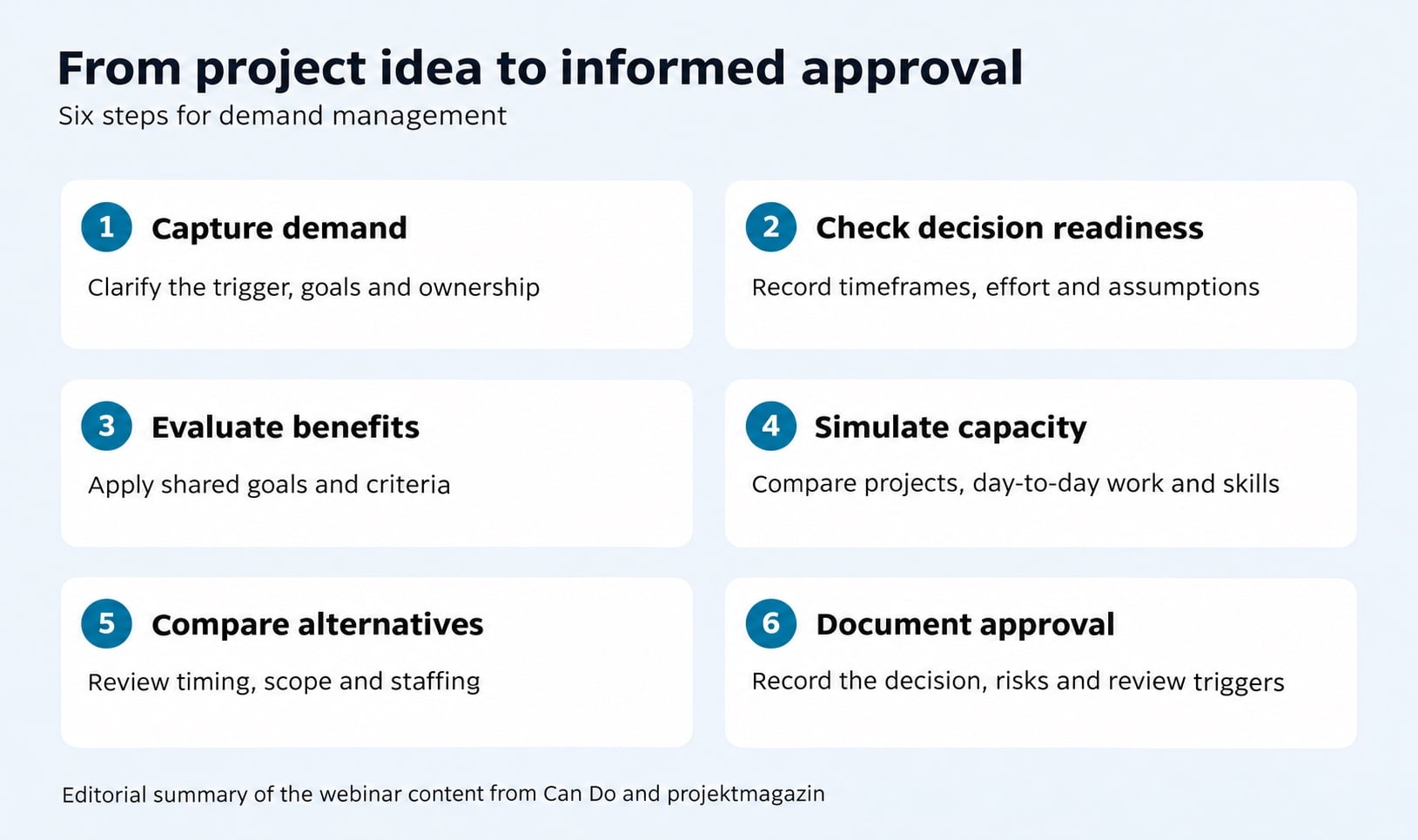
An effective demand process has six steps: capture requests, check readiness for a decision, assess value, simulate capacity, compare alternatives and document the decision.
The following structure brings the webinar's ideas together in a practical workflow.
Capture demand, check readiness, assess value, simulate capacity, compare alternatives and document approval. Open the image to view it full size.
1. Capture project requests consistently
Create a clear entry point for new initiatives. This could be a demand form, an agreed backlog or an integrated sales pipeline. Consistent mandatory information and clear ownership are essential.
An initial assessment should include at least:
The problem or reason for the request and its expected outcome
Contribution to a specific business goal
A responsible sponsor
Desired start date and approximate duration
Estimated effort by required role or skill
Important dependencies and fixed deadlines
An estimate of how likely the initiative is to proceed
2. Prepare for a decision without false precision
An early request needs a credible order-of-magnitude estimate, but not necessarily a fully developed project plan. When experience is insufficient for an exact effort figure, a justified estimate such as 200 to 300 person-days can be more useful than an apparently precise single value.
The webinar uses examples such as a start within a particular quarter, a duration of twelve to fifteen months and a role requirement of 200 to 300 person-days. These estimates reflect current knowledge and must be supported by understandable assumptions.
If a request cannot explain its expected value or approximate resource requirements, it is not ready for a decision. The next step is to gather the missing information.
3. Evaluate value against shared criteria
First define what the business wants to achieve. Meaningful assessment criteria follow from those goals. A project might contribute to financial results, product strategy or improvement of a core process.
Avoid criteria that measure the same benefit in different words. Define what justifies each rating: what demonstrable change warrants a high score?
4. Simulate new demand against real capacity
Assess the new request alongside active projects and other possible initiatives. Include working patterns, day-to-day operations, absences and when the required skills are available.
A probability of proceeding helps assess uncertain initiatives. It describes how likely the project is to go ahead under the stated assumptions. It is different from the probability of the project's eventual success.
Probability-weighted average demand alone is insufficient for bottleneck decisions. Two initiatives starting together may overload a specialist role even when their averaged demand looks manageable. Examine specific combinations and peak loads as well.
5. Compare start dates and alternatives
If simulation identifies a critical load, compare possible responses. What changes if the start is delayed? Can scope be adjusted? Are suitable skills available at another location? What would happen if another initiative moved?
The aim is a workable combination. A high score does not replace this judgement, and an identifiable risk does not automatically require rejection.
6. Document approval and its assumptions
Record what is approved, the assumptions that apply and the known risks. Also document who made the decision and any agreed actions.
This makes it possible to distinguish problems caused by changed circumstances from those foreseeable at approval. Reassess the decision when effort, availability or strategic objectives change materially.
Which criteria should businesses use to prioritise projects?
Projects should be assessed for their contribution to business goals, then checked for feasibility.
A transparent assessment combines measurable value, strategic importance and mandatory requirements. Resource risks and dependencies also determine when a project can realistically start.
An example scoring matrix
This matrix is an editorial example, not a prescribed webinar method. Adapt the criteria, weights and scoring definitions to your goals. Award zero to five points for each criterion.
Value criterion
Weight
Assessment question
Strategic contribution
40%
Which defined business goal does the initiative directly support?
Financial value
35%
What additional financial contribution or saving is credibly supported?
Operational improvement
25%
What measurable process or quality improvement will result?
Calculate a score from 0 to 100: Score = (strategy points × 0.40 + financial points × 0.35 + improvement points × 0.25) ÷ 5 × 100.
Scores of five, four and three produce an overall score of 83. This helps compare requests. It is neither a probability of success nor objective proof of future value.
Assess mandatory projects and capacity risks separately
Mandatory initiatives, such as those needed to meet legal requirements, need a protected place in the portfolio. The webinar discusses assigning them high priority in scoring. In practice, a separate mandatory status and deadline also help ensure they are not dependent on discretionary value comparisons.
Mandatory projects still need realistic resource plans. Their status creates no extra capacity. Check early which other initiatives need adjusting.
Practical example: why a valuable project request may need to wait
A simplified fictional example, not an analysis of a Can Do customer.
After allowing for day-to-day work and absences, an engineering team has 160 person-days available for projects in a given month. Approved initiatives already require 140 person-days. A new request needs another 40 in the same month.
Monthly capacity and demand
Person-days
Actual available project capacity
160
Demand from approved projects
140
Additional demand from the new initiative
40
Total demand with an immediate start
180
Calculated capacity shortfall
20
Total demand is 112.5% of available project capacity. Even a strategically valuable initiative therefore creates a conflict. If some of those 40 person-days require a specialist who is already fully committed, the situation becomes more difficult.
One option is to postpone the start and reassess the next period. Alternatively, adjust scope or staffing. The right choice depends on deadlines, value and dependencies. The monthly calculation alone is not a complete portfolio simulation.
What role does AI play in demand management?
AI can analyse requests, identify similar initiatives and support assessments of risks and resources.
Language models, pattern recognition and computational simulation perform different tasks. A capacity calculation is not automatically an AI application.
Identify patterns and test assumptions
Comparisons with completed or active projects can reveal unrealistic estimates or duplicate initiatives. They become more useful when data is structured and comparable. A similar project name alone does not establish comparable circumstances.
Reveal bottlenecks and staffing alternatives
Algorithms and AI can analyse the availability of roles, skills and people alongside project requirements. This helps identify critical combinations and possible alternatives earlier. It does not replace a practical assessment of whether a person can actually be assigned.
Support strategic assessments
Language models can compare project descriptions with stated business goals and highlight questions or contradictions. Their suggestions need verifiable reasoning. Persuasive wording alone is not a reliable value assessment.
Thomas Schlereth also discusses further approaches in the webinar, including reviewing proposed decisions with a language model and searching for favourable portfolio combinations. These are development and experimentation perspectives, not evidence that all such capabilities are available as standard features. Management retains responsibility for approval.
How does Can Do support demand management in practice?
Can Do connects project requests with portfolio, project and resource management, making it possible to assess the effects of a new initiative before approval. The following capabilities are described in Can Do's product information.
Assess project requests systematically
Demands can be entered manually or imported through connected HubSpot or Salesforce sales pipelines. Scores, budgets, availability and probabilities of proceeding support assessment and approval.
Consider roles, skills and actual availability
Can Do supports planning with roles, skills and approximate estimates. Working patterns, absences and recurring operational workload are included in capacity calculations. This helps compare early project requirements with the real working situation.
Compare scenarios before deciding
Simulation mode lets users explore alternative dates and resource configurations without immediately changing operational plans. Risk analysis and suggestions for alternative resources also support bottleneck assessment.
Further information is available in the Can Do feature overview and the article on scenario planning in simulation mode.
Test your next initiative in a Can Do demo
Find out which additional projects your organisation can take on and where bottlenecks could arise. Discuss your requirements with the Can Do team and see how project requests, capacity planning and simulation work together.
Evaluate new initiatives, identify resource bottlenecks and prepare better-informed project approvals.
Webinar with projektmagazin: demand management in practice
Thomas Schlereth explains the organisational and methodological foundations of informed project approval. The focus is on how resource bottlenecks arise, how to establish transparent priorities and how to simulate new initiatives. The presentation covers methods and does not include a product demonstration.
Websession: evaluating and prioritising projects
The joint Can Do and projektmagazin session explores the ideas in this article in greater depth: assessing requests consistently, setting priorities and identifying resource bottlenecks before approval. An English recording is not currently available.
Checklist: is your demand management ready to support decisions?
Use these questions in your next portfolio or PMO meeting:
Is there one consistent entry point for project requests?
Are business goals specific enough to assess a project's contribution?
Does each decision-ready request have an owner and an approximate resource requirement?
Are uncertain figures clearly identified as assumptions or estimated durations and effort?
Are operational work, absences and working patterns included?
Are bottlenecks in key roles checked across all projects?
Are alternatives compared before approval?
Are decisions, accepted risks and triggers for reassessment documented?
Several unanswered questions show where the process can improve. This checklist is a working aid, not a validated maturity model.
Frequently asked questions about demand management
What information does a project request need?
A request needs a defined need, expected outcome, responsible owner, approximate timeframe and estimated effort by role or skill. It should include important dependencies, fixed deadlines and, for uncertain initiatives, the probability of proceeding. A complete detailed plan is often unnecessary for the initial assessment.
How can projects be prioritised more objectively?
Define shared goals, a small number of weighted criteria and clear scoring definitions. Then assess resource requirements, dependencies and risks. Scores make judgements more comparable but do not remove all subjective assumptions. Documented reasoning and later reviews of realised value improve transparency.
What does the probability of proceeding mean?
It describes how likely an unapproved initiative is to go ahead under the stated assumptions. It helps assess potential future demand. It does not describe the probability of project success or replace scenario checks in which several initiatives proceed together.
Can demand management prevent resource bottlenecks?
It can reveal foreseeable overload before approval and enable preventive action. It cannot guarantee disruption-free delivery. Absences, new information and changed requirements can affect plans and require reassessment.
Who is responsible for project approval?
The designated decision-making body, such as a portfolio board or senior management, is responsible. The PMO prepares consistent information, while departments and resource managers assess value and feasibility. Software and AI support the judgement but do not take over management accountability.
When is demand management software worthwhile?
Software is particularly useful when many initiatives compete for the same resources, capacity spans departments or alternatives need regular recalculation. A clear process, understandable assessment criteria and maintained data remain essential. Can Do supports a combined view of demands, projects and resources.
Project approvals shape a sustainable portfolio
Demand management starts where an idea becomes a commitment. Bringing together value, available skills and the effects on existing projects enables a deliberate choice: start now, start later, adjust or reject.
The first practical step is a shared view of the next request and already committed capacity. A Can Do demo shows how integrated planning and simulation can support that assessment.
Which projects can you realistically commit to?
Every new commitment consumes capacity, often the same specialist skills already needed elsewhere. Whether a project is worthwhile is only part of the decision. Equally important is whether, and when, the organisation can deliver it realistically.
Gain clarity before a good idea becomes the next overload.
In a personalised Can Do demo, explore how to simulate initiatives before approval, identify role and skill bottlenecks and compare alternative start dates. See how Can Do can support your project and resource decisions.
If you would prefer to discuss your current situation first, a free initial conversation can identify your main project prioritisation and capacity planning challenges and whether Can Do fits your requirements.


 Editorial Team
 Ariane Becker : 06.11.2026