<img height="1" width="1" style="display:none;" alt="" src="https://px.ads.linkedin.com/collect/?pid=2740041&amp;fmt=gif">

Security & Operations

AI Compliance

    Discover Can Do

    Explore the platform for project and multi-project management in a personal demo.

    Book a personal demo

      User Perspectives

      User Benefits

        Stay Up to Date

        Newsletter

          4 min read

          AI in Project Management: Resource Planning in Machinery and Plant Engineering

          Why AI in project management matters now

          Germany’s machinery and plant engineering sector is under pressure from demographic change, digitalisation and intense competition. At the same time, value creation is shifting towards design and development.

          Planning projects in this environment requires modern tools, transparent data and realistic resource planning. This is where AI in project management adds measurable value: making skills visible, identifying bottlenecks early, assessing feasibility reliably and building teams that can deliver.

          Thomas Schlereth, Managing Director of Can Do GmbH“Skilled professionals are scarce and expensive. AI-based software helps companies identify their employees’ capabilities and deploy them precisely where they are needed. This makes it possible to assess project feasibility using facts and avoid planning mistakes.”
          — Thomas Schlereth, Managing Director of Can Do GmbH

          Contents

          1. Applying individual skills to specific project needs
          2. Building effective teams from scarce specialist resources
          3. Saving time and money on project administration
          4. Resource management with artificial intelligence
          5. How AI learns the way teams solve problems

          1. Applying individual skills to specific project needs

          Modern resource management ensures that the right people work on the right tasks at the right time, without becoming overloaded. Its foundation is integrated skill and role management: role profiles, competencies, certifications, experience and locations are recorded and matched against project requirements.

          AI in project management turns this into more than a list of data:

          • Skill matching: match requirements with employees who have the appropriate qualifications and availability.
          • Realistic scheduling: include capacity, working patterns, leave and routine operational workloads in the plan.
          • Budget control: better allocation reduces rework and expensive last-minute measures.

          2. Building effective teams from scarce specialist resources

          In matrix organisations and multi-site environments, it is particularly important to make scarce specialist capacity visible across the business. The software identifies the skills required, evaluates combinations of locations and teams, and suggests alternative staffing options.

          Practical benefits

          • A portfolio-wide view: do we have enough people for all current and planned projects?
          • From template to project plan: plans generated from templates are automatically checked for resource bottlenecks.
          • Global coordination: coordinate availability across locations while accounting for travel time and the cost of switching assignments.

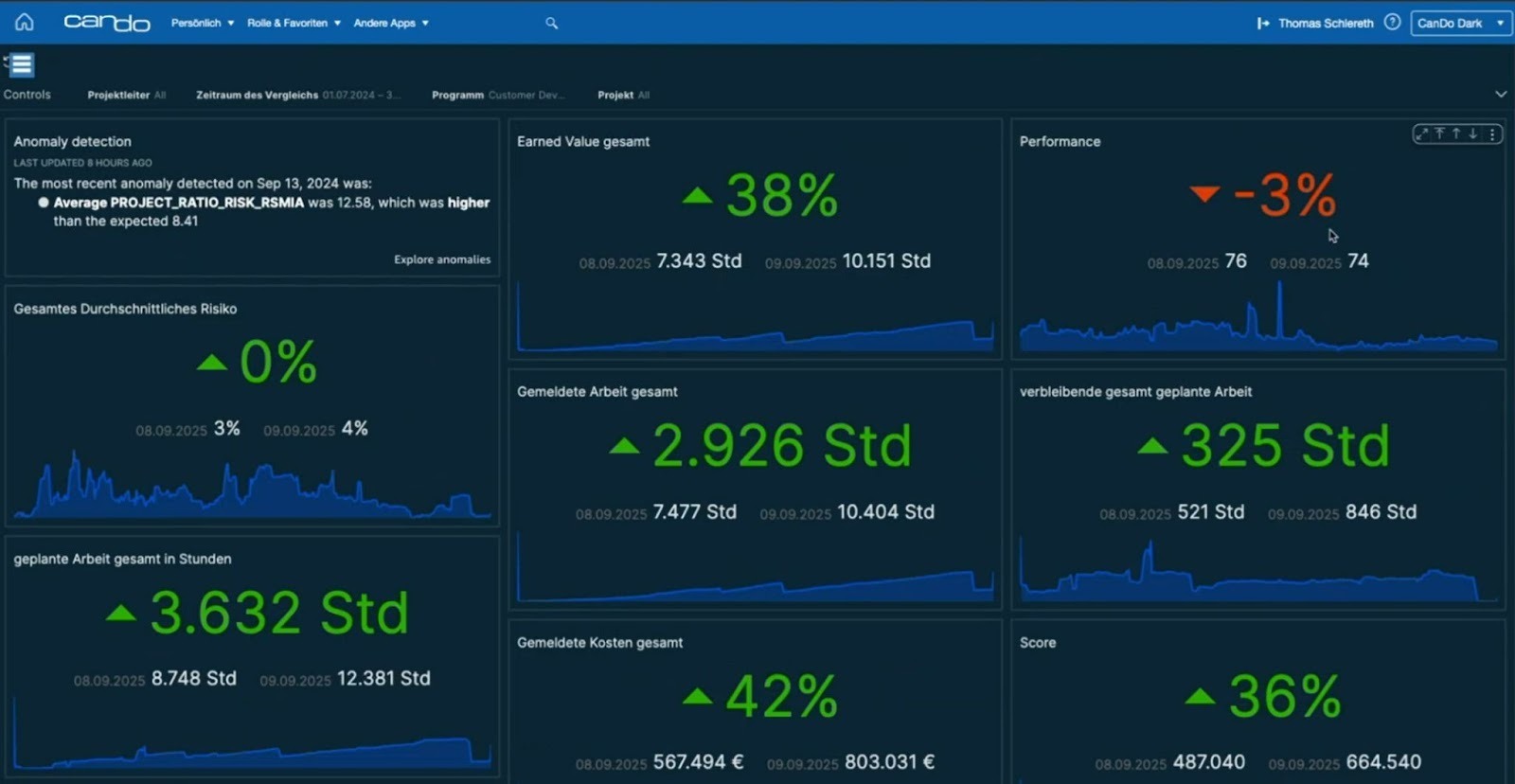
          Can Do software screenshot illustrating AI-supported project management

          3. Saving time and money on project administration

          Automation is a key advantage. Based on practical experience, project managers can save up to 25% of the time they spend on project administration, and department heads often save even more, because allocation, schedule checks and status reports become faster and more consistent. Additional benefits include:

          • Feasibility checks and risk assessment in one step: fewer planning mistakes and less firefighting.
          • Transparency for HR: identify skill requirements and scarce resources early so that training or recruitment can start in time.
          • Improved delivery capability: address overload and bottlenecks before they disrupt projects.

          4. Resource management with artificial intelligence

          Pattern recognition, simulations and neural networks take resource and skill management further:

          • Scenario-based decisions: “What if we start in week 45?” AI simulates the impact on schedules, workloads and risk.
          • Predictive workload planning: individual working patterns inform forecasts, while AI selects relevant data rather than calculating everything indiscriminately.
          • Rolling workforce planning: account for short-term changes without derailing long-term plans.
          • Risk analytics: sophisticated methods, including stochastic techniques, identify critical paths and suggest possible actions.

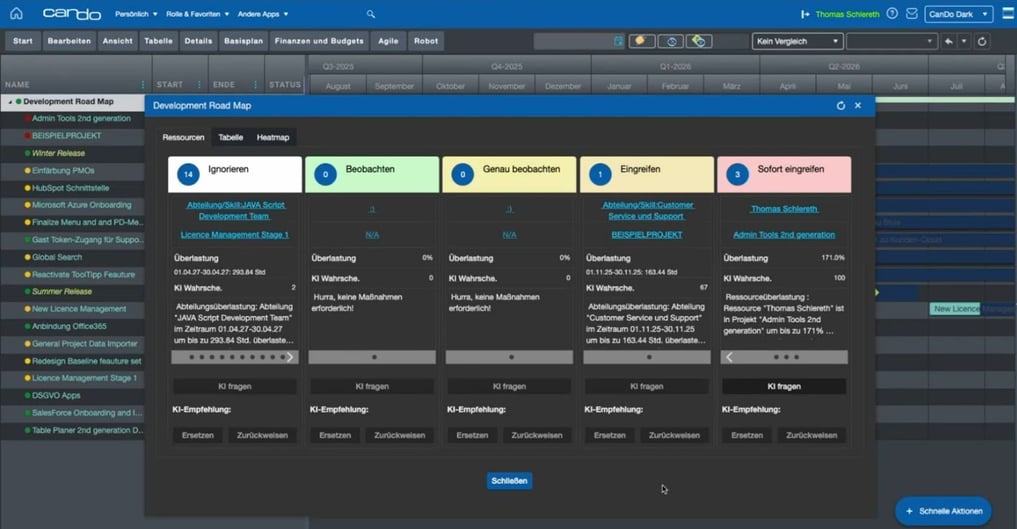
          Can Do software view illustrating AI-supported resource and project planning

          5. How AI learns the way teams solve problems

          A key strength of neural networks is their ability to learn relationships. By analysing many comparable situations, AI learns how teams solve problems. Practical effects include:

          • Automatic replacement suggestions: when someone is off sick, AI identifies suitable alternatives with similar skills and available capacity.
          • Multi-factor assessment: urgency, the feasibility of switching assignments, previous team configurations and project managers’ decisions are taken into account.
          • Learning from feedback: accepting or rejecting suggestions helps the network become more precise and its recommendations more relevant.

          Over time, this creates an intelligent, company-wide resource model that makes the best use of team capabilities.

          Practical checklist: getting started with AI in project management

          • Clarify your objectives: where can AI make the biggest difference: staffing, sequencing or risk?
          • Create a skill taxonomy: define roles, proficiency levels and certifications.
          • Connect your data: integrate HR and ERP systems, historical project data and effort records.
          • Define the rules: account for compliance requirements, travel times and qualification criteria.
          • Run a pilot and track KPIs: examples include on-time delivery, work in progress (WIP), utilisation and planned-versus-actual variance.
          • Support change and adoption: ensure transparency, explainability and regular feedback loops.

          From Excel to reality: planning with AI and BI — webinar recording

          Many projects are set up to fail on day one because feasibility, capacity and risks have not been properly assessed. Can Do makes planning realistic, transparent and ready to support decisions. Watch the recording to see how it works. The recording is in German; the accompanying article is in English.

          • Realistic capacity: leave, part-time schedules, routine workloads and sick days are reflected in the system, so projects start with reliable facts.
          • Simulations for informed decisions: Can Do automatically calculates numerous scenarios and makes probabilities and risks visible. “What if we start in November rather than December?”
          • Focus on relevant risks: AI filters out noise and highlights critical overload so project managers can act where it matters.
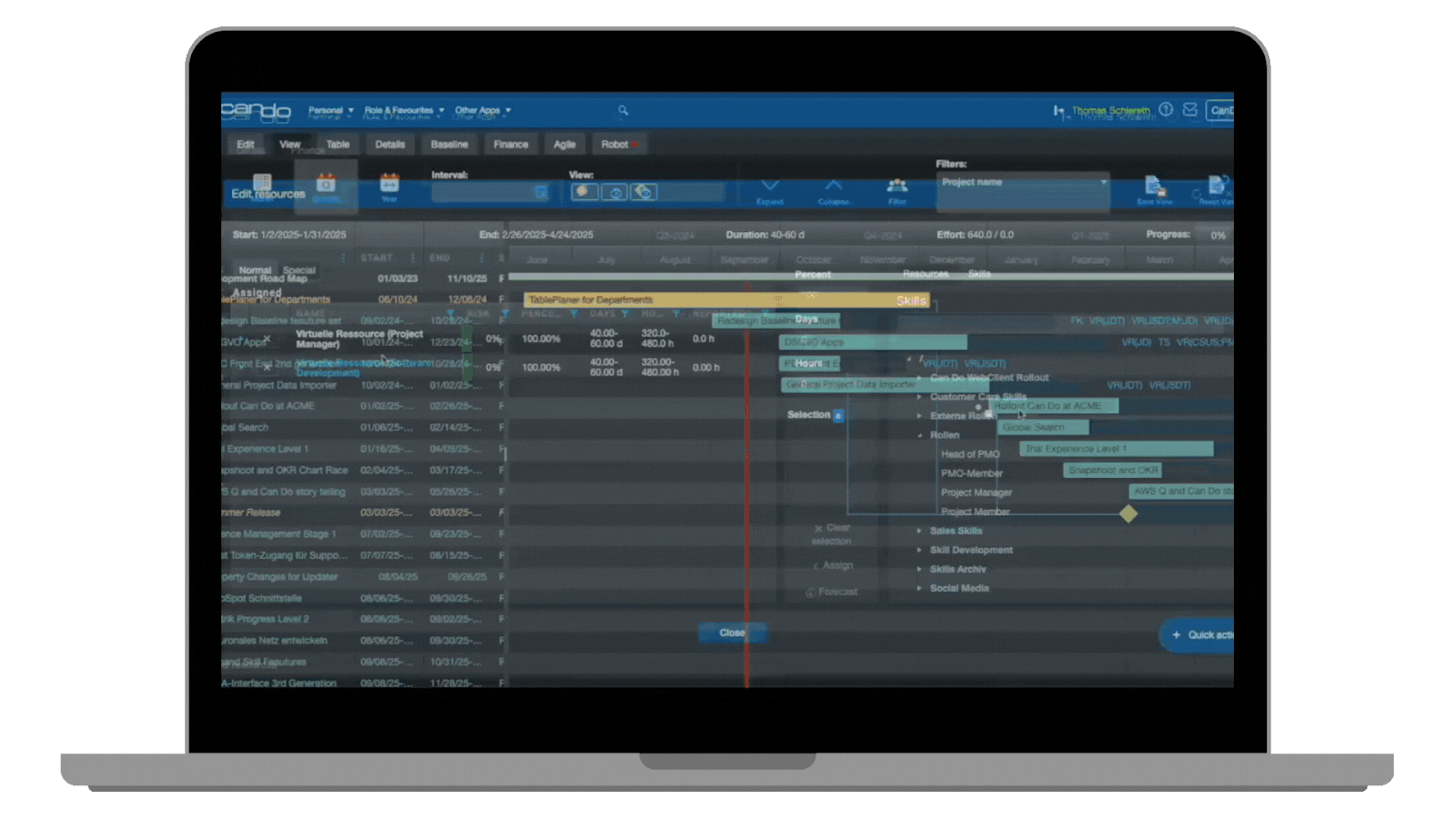
          • Resource suggestions from neural networks: who can take on the task and actually has time? The system automatically suggests suitable employees.
          • BI dashboards for portfolio confidence: trends, anomalies and forecasts provide real-time transparency, including risk trend analysis across quarters.
          • Less administration, more control: reduce maintenance work and get faster answers to questions such as “Can we bring this forward?” or “Where could overload occur next week?”

          AI meets reality: project and resource planning webinar recording in German

          🎥 Watch the recording (in German) and see Can Do in action, including AI-supported resource planning, skill matching, early bottleneck detection and realistic scenarios.

          Conclusion

          AI in project management makes resource planning in machinery and plant engineering faster, more reliable and grounded in facts. Skill-based staffing, scenario simulations and recommendations that learn from feedback reduce overload, prevent planning mistakes and improve predictability, helping teams deliver.

          Can Do: AI-powered management software for professionals

          Can Do all-in-one software for portfolio, project and resource management

          Can Do is the all-in-one solution for portfolio, project and resource management. Optimise your projects, resources and risks with Can Do, trusted by leading German companies.

          • Automate skill and resource management with advanced AI tools.
          • Keep track of portfolios and projects with real-time visualisations.
          • Make better decisions through comprehensive risk assessments and business intelligence.

          Book a free demo to experience Can Do live in 30–45 minutes and discuss your questions directly with our experts.
          👉 Book your free demo

          A quick introduction to Can Do (video in German): an overview of features, benefits and use cases.
          👉 Watch now (in German)

          Frequently asked questions

          1. What is AI in project management?

          AI supports planning, staffing and scheduling through pattern recognition, scenarios and forecasts, helping teams make decisions based on facts rather than intuition.

          2. How does AI help with resource planning in machinery and plant engineering?

          It matches role requirements with skills and availability, identifies bottlenecks early and suggests alternative team configurations, including across different locations.

          3. What data do I need to get started?

          You need roles and skills, availability data such as working hours, leave and routine workloads, and project history. Connections to HR, ERP and calendar systems may also be useful. Cleaner data leads to more accurate suggestions.

          4. What does AI offer beyond Excel and traditional project management tools?

          What-if simulations, predictive workload forecasts, resource recommendations that learn from feedback and explainable risk indicators help reduce administration and improve project control.

          5. What is a practical way to start?

          Begin with a pilot covering one or two departments or programmes, clear KPIs such as on-time delivery, WIP and utilisation, defined compliance and qualification rules, and short feedback cycles.

          6. Is the approach explainable and GDPR-compliant?

          Choose tools with explainable AI features that provide reasons for recommendations, role-based permissions, EU hosting options and transparent data protection processes.

          Ariane Becker is in continual exchange with interested parties from various industries. Her main focus is to bring the right information and suitable experts together and getting directly involved in the use cases and the software.

          How to Implement Accurate Skills Planning

          Learn how employee skills support better project staffing. Read Can Do’s English introduction to the Computerwoche ...

          Read More

          Strategic and Operational Project Portfolio Management

          Explore portfolio systems, simulation and project approval in Can Do’s three-part project portfolio management series. ...

          Read More

          Can Do Presents AI-Optimised Working Time Planning

          Archive: Can Do announced its Can Do Hours app for AI-supported time tracking and task planning at DIGICON 2018. Read ...

          Read More