
Artificial intelligence is increasingly becoming a practical tool in project management. In complex project environments in particular, AI helps organisations identify resource bottlenecks earlier, assess risks more realistically and make better-informed decisions.
The purpose is to support project managers and PMOs. AI creates value by analysing large volumes of project, resource and portfolio data, identifying relationships and helping the people responsible make decisions.
This capability is becoming increasingly relevant for companies managing many concurrent projects, limited resources and changing priorities.
What does AI in project management mean?
AI in project management means using artificial intelligence to analyse, evaluate and support decisions about projects, resources and portfolios.
It goes beyond displaying existing data in a conventional planning system. AI can identify patterns, risks and relationships, evaluate different scenarios and help project leaders reach well-founded decisions faster.
Typical applications include:
- portfolio planning;
- resource management;
- skills-based resource planning;
- risk identification;
- early warning systems;
- reporting and analysis.
Can Do's guide therefore describes AI as an additional layer of decision support and evaluation within project management.
Why is AI becoming more important in project management?
Project environments are becoming more complex.
More projects run at the same time. Resources are increasingly scarce. Priorities change at short notice. Decisions often need to be made before planning data is fully defined.
This is where conventional planning approaches reach their limits.
The more dependencies there are between projects, resources and priorities, the harder it becomes to keep track of every effect manually.
AI is therefore particularly relevant to:
- PMOs;
- organisations managing multiple projects;
- IT organisations;
- engineering companies;
- machinery and plant engineering companies;
- project-based service providers.
The benefits grow when many projects run in parallel and resources or skills are in short supply.
5 practical use cases for AI in project management
1. AI-supported portfolio planning with uncertain estimates
Many portfolio decisions need to be made before key project data is fully defined.
Typical uncertainties include:
- changing start dates;
- rough estimates of effort;
- fluctuating resource availability;
- shifting project priorities.
Conventional planning systems often work best with fixed values. Yet these are frequently unavailable in the early planning stages.
AI can take a different approach.
Start dates, durations and effort can be represented as estimated intervals or probabilities. These can be used to simulate different scenarios and evaluate their effects on capacity, risks and project objectives.
This allows companies to answer questions early, such as:
- Can a new project realistically be delivered?
- Where would additional resource bottlenecks arise?
- Which prioritisation conflicts could occur?
- How would a new project affect the existing portfolio?
The key advantage is that risks become visible before projects are started or given final approval.
2. Identify resource bottlenecks and prioritise them effectively
A calculated overload does not automatically mean a project is genuinely at risk.
A short-term bottleneck affecting a less critical task may be manageable. The same overload immediately before a key customer milestone could have significant consequences.
Intelligent resource planning should therefore assess how critical an overload is, as well as detect that it exists.
AI can take different contextual factors into account, including:
- how soon the overload will occur;
- project priorities;
- critical milestones;
- dependencies;
- the duration of the overload;
- the severity of the overload.
Risks are prioritised as well as displayed. Project leaders can concentrate on the cases that truly matter instead of having to work through a large number of alerts.
3. Plan resources around skills
In many companies, resource planning centres on named individuals.
If a particular person is unavailable or already fully allocated, a bottleneck can quickly arise.
In practice, the decisive factor is often the skills required, rather than the person originally assigned.
AI can analyse skills, experience and availability and evaluate alternative team compositions.
This can help answer questions such as:
- Who has similar skills?
- Which employees are available?
- Who could take on particular tasks?
- Which alternative team compositions are realistic?
Can Do follows this approach. The system considers skills, experience profiles and availability to identify alternative resource combinations.
This is particularly relevant when dealing with:
- unexpected absences;
- limited specialist resources;
- many concurrent projects;
- large resource pools;
- changing project requirements.
4. Use AI as an early warning system for projects and portfolios
Many project problems only become visible once schedules, budgets or quality are already under pressure.
The underlying problem, however, often develops earlier.
Examples include:
- too many projects starting at the same time;
- unrealistic priorities;
- key resources that remain overloaded;
- skills shortages;
- critical project dependencies.
AI can identify these patterns early.
It does this by continuously analysing resource utilisation, project priorities, skills shortages, project dependencies and changes across the portfolio.
This changes the perspective.
Instead of waiting to ask, “Why is this project in trouble?”, companies can recognise warning signs earlier: “Which developments suggest that this project or portfolio could run into difficulty?”
This is one of the most important benefits of AI in project management: the shift from reacting to problems towards proactive decision support.
5. Automate reporting and analysis
Reporting remains one of the most time-consuming administrative tasks in many companies.
Data is brought together manually, figures are consolidated repeatedly and reports take considerable effort to prepare.
As well as creating a heavy workload, this carries the risk that decisions will be based on information that is already out of date.
AI can continuously analyse project, resource and financial data and extract relevant information.
This includes, for example:
- risks;
- trends;
- emerging developments;
- management views;
- information to support decisions.
Can Do combines AI with business intelligence. According to the guide, this includes more than ten interactive dashboards and over 200 analyses with drill-down capabilities.
Reporting becomes a tool for ongoing project and portfolio management, reducing its role as a purely administrative task.
What are the benefits of AI in project management?

The greatest value of AI does not necessarily come from maximising automation.
What matters is enabling companies to assess complex situations faster and in a more structured way.
AI can help organisations:
- manage projects more reliably;
- identify risks earlier;
- make priorities more transparent;
- plan resources more realistically;
- base decisions more firmly on data;
- reduce the effort required for reporting.
The guide describes this change as a shift from reactive project management to proactive decision support.
What are the limitations of AI in project management?
Project accountability remains with people
AI can support decisions, accelerate analysis and make risks visible.
People remain responsible for prioritisation, communication and strategic decisions.
Project managers, PMOs and leaders therefore remain essential.
Their role changes: less time needs to be spent on manual analysis, leaving more time for evaluation, leadership, prioritisation and strategic management.
Data quality remains essential
Even powerful AI needs structured, consistent data.
Incomplete, contradictory or poorly maintained project information does not automatically become a sound basis for decisions simply because AI is involved.
Alongside AI, companies should therefore invest in well-defined processes, clear data structures and consistent project standards.
AI should solve specific project management problems
The number of AI features is less important than whether AI helps solve a real problem in project delivery.
These problems might include:
- limited resources;
- uncertain planning data;
- critical dependencies;
- time-consuming reporting;
- complex portfolios.
AI should therefore be part of project and portfolio management, rather than an isolated additional feature.
What should companies consider when using AI with sensitive project data?
As AI becomes more deeply involved in operational and strategic decisions, data sovereignty, transparency and traceability become increasingly important.
Project portfolios can contain sensitive information, including:
- product development;
- investments;
- customer data;
- internal resource allocation decisions;
- strategic initiatives.
The technical architecture of an AI solution therefore plays an important role.
Can Do follows a sovereign AI approach.
According to the guide, its AI capabilities were developed entirely in-house and integrated directly into the platform. Project, resource and company data is not transferred to external public AI providers.
This can be an important selection criterion, particularly for regulated industries, engineering environments and companies handling sensitive development or project data.
Guide: 5 practical examples of AI in project management
For a closer look, Can Do's free guide “How AI Supports Project Management” provides five practical use cases and further background information.
The guide explains:
- how AI can handle uncertain planning estimates;
- how resource bottlenecks are prioritised;
- how skills-based resource planning works;
- how AI can be used as an early warning system;
- how reporting and analysis can be automated.
Its focus is on practical applications and the productive use of AI in project and resource management.
How AI Supports Project Management: five practical use cases, explained clearly and concisely.
Download the free guide.
Frequently asked questions about AI in project management
How is AI used in project management?
AI can analyse project, resource and portfolio data, identify risks, simulate scenarios and support project leaders in making decisions. Typical applications include portfolio planning, resource management, risk management, early warning systems and reporting.
Can AI replace project managers?
No. AI can accelerate analysis and prepare information for decisions. Accountability, leadership, communication and prioritisation remain human responsibilities.
Can AI help with resource planning?
Yes. AI can analyse skills, experience, availability and project priorities together. This makes it possible to identify alternative resources or team compositions faster.
Which companies benefit most from AI in project management?
The benefits are particularly significant for companies with many concurrent projects, limited resources, high project complexity, numerous dependencies and frequently changing priorities. These include PMOs, engineering companies, IT organisations, and machinery and plant engineering companies.
What is the greatest benefit of AI in project management?
The greatest benefit is the ability to analyse complex relationships faster and make risks visible earlier. This enables companies to make decisions before problems escalate during project delivery.
Putting AI into practice with Can Do
How Can Do uses AI in project management
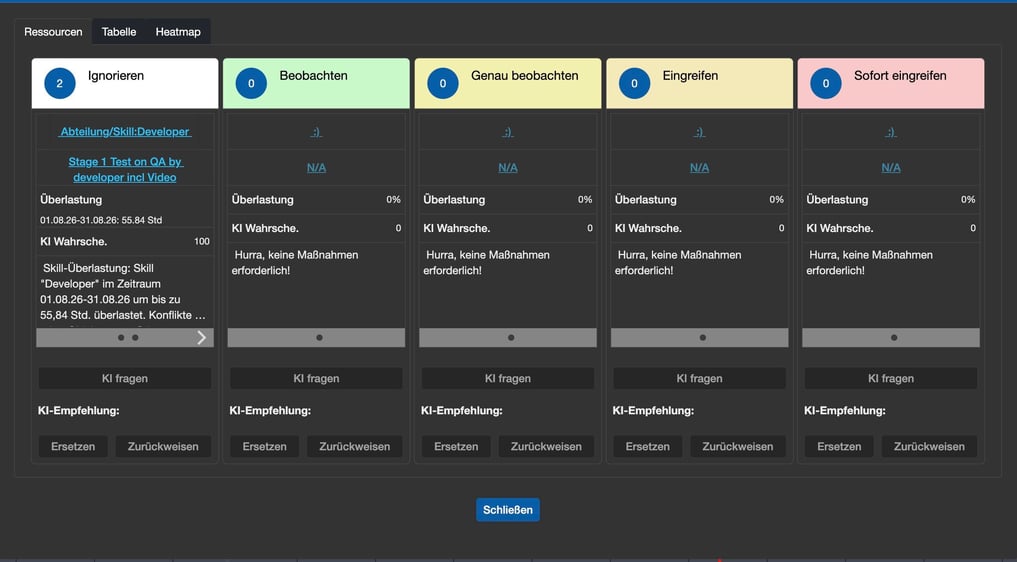
Can Do treats AI as an integral part of the platform.
It is designed as an integrated layer for analysis, evaluation and management across portfolio, project and resource management.
The focus is on:
- AI-supported portfolio simulation with uncertain estimates
- Probabilistic forecasts for dates, durations and risks
- Automatic identification of critical resource risks
- Real-time risk analysis when plans change
- AI-based suggestions for alternative resources based on skills
- Pattern recognition and trend forecasting that look ahead as well as back
|
This differs from solutions that use AI only as a generic assistant alongside the core project management system.
Discover Can Do in a personalised demo
Would you like to see what AI-supported project and resource management could look like in your own organisation?
In a short introductory conversation, we discuss your requirements and current situation to establish whether Can Do is a suitable fit.
We then show you Can Do in a personalised product demo tailored to your requirements. The guide follows the same process: an introductory conversation followed by an individual demo.
Book your personalised Can Do demo.
Download the guide “How AI Supports Project Management”.


 Thomas Schlereth : 05.11.2026

