Why many AI features in project management are overestimated
Artificial intelligence has found its way into almost every project management software category. Few vendors now avoid terms such as “AI-powered”, “predictive planning” or “smart resource management”. For businesses, this creates a new problem: choosing software has become more confusing.
There are substantial differences between meaningful decision support and marketing. Many AI features automate individual tasks without addressing the underlying challenges of project delivery. Others produce impressive visualisations but few actionable recommendations.
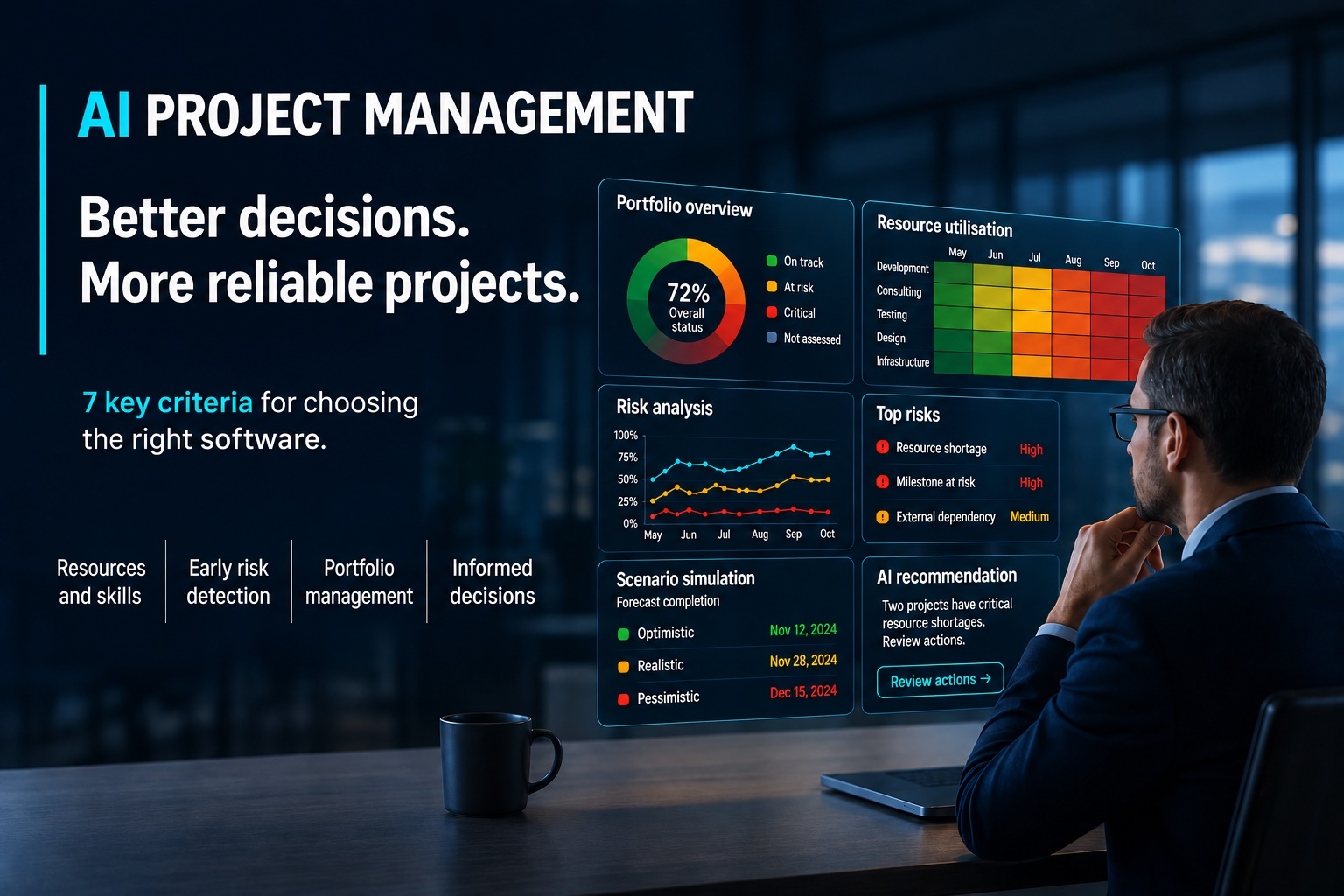
When choosing AI project management software, businesses should examine which problems it addresses and how well it fits into their planning and decision-making processes.
AI in project management: focus on decision quality
Why automation alone often falls short
Many AI solutions in project management operate mainly as chatbots. They access data from an individual project or project file and turn it into summaries, task descriptions or written status updates. These systems often cannot analyse relationships across projects at portfolio or server level. Nor do they necessarily change project plans, update data or create presentations independently. Their main output is text, while people remain responsible for managing projects and acting on the information.
The central challenges are usually elsewhere: unclear priorities, resource bottlenecks, limited visibility of skills, unrealistic delivery commitments and a lack of portfolio-wide insight. In complex project organisations, AI creates the greatest value when it assesses risks, prioritises bottlenecks and reveals dependencies. It should also develop practical options and simulate their effects and feasibility before changes are adopted in project and resource plans.
Why AI assessment matters strategically
Modern AI systems should help interpret data as well as display it. A calculated overload says little on its own about how critical a risk is. Context makes it meaningful.
Effective AI considers factors such as how soon a bottleneck will occur, dependencies between projects, critical milestones, portfolio priorities and how long overload will last. Businesses should look for systems that enable better decisions.
The seven criteria that matter
1. Does the software provide real visibility of resources and skills?
Why planning with named people is no longer enough
Many businesses still base project planning primarily on individuals. This often works for small teams but does not scale easily. With several concurrent projects, available skills matter as much as available hours.
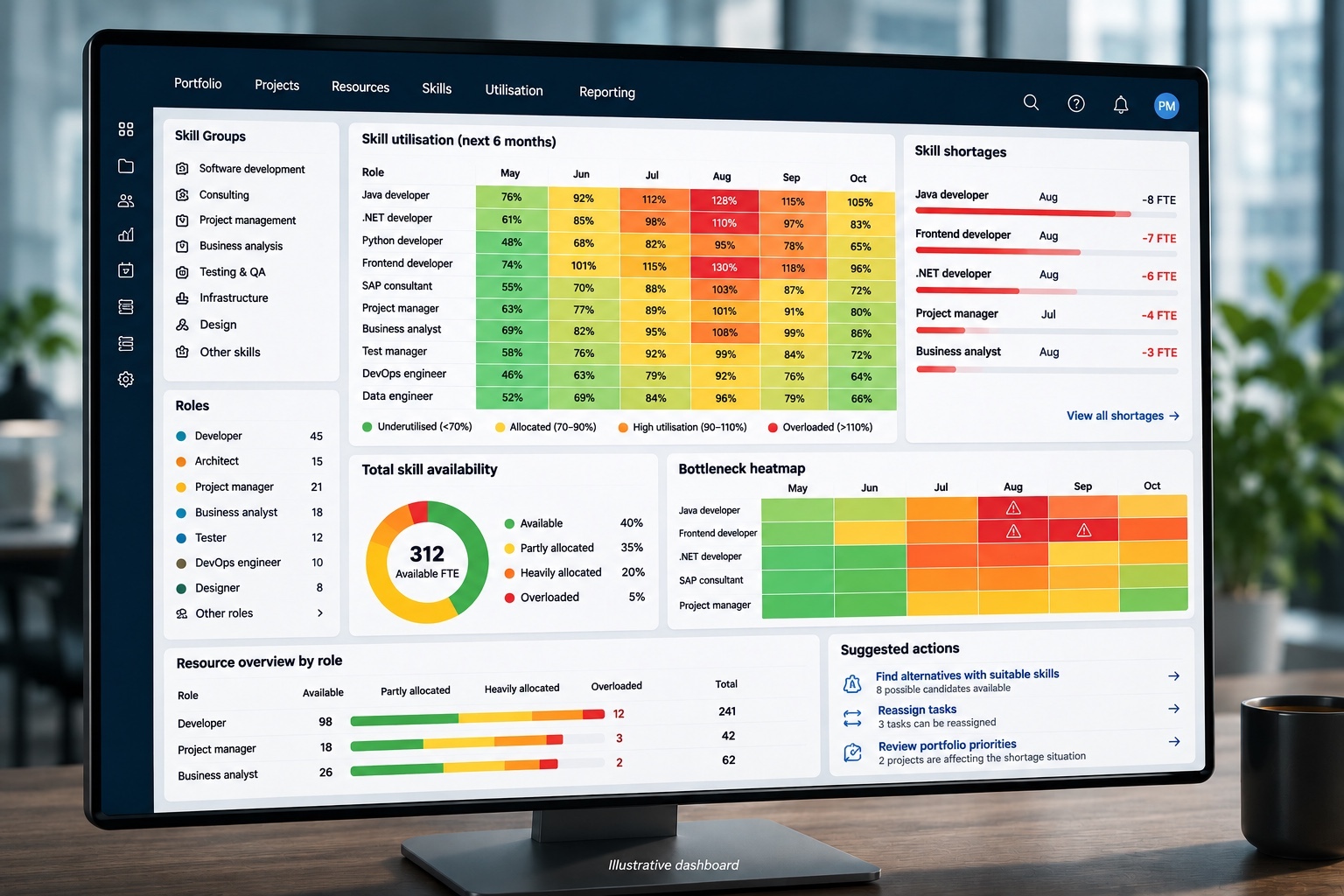
Role- and skills-based planning is therefore becoming more important. Modern project management software should make roles, skills, proficiency levels and capability gaps visible, as well as managing people.
What to look for
It is not enough to record skills. They must be usable as ongoing planning requirements. Can projects be planned using combinations of roles, skill levels, locations, languages and other criteria? For example, a developer based in Munich who speaks English and has at least proficiency level three.
These requirements should remain part of the plan, rather than simply acting as filters used once to select a person. This lets the system continually check whether the required skills are available. AI-supported solutions can also identify medium- and long-term needs for additional skills, new employees or targeted training and make this information available to HR.
Can bottlenecks be analysed? Can skill data be maintained and evaluated systematically? Without this transparency, AI often adds little depth.
Illustrative dashboard, not a screenshot of the Can Do product. Open the image to view it full size.
2. Does the AI assess risks in context?
Why a calculated overload is not automatically critical
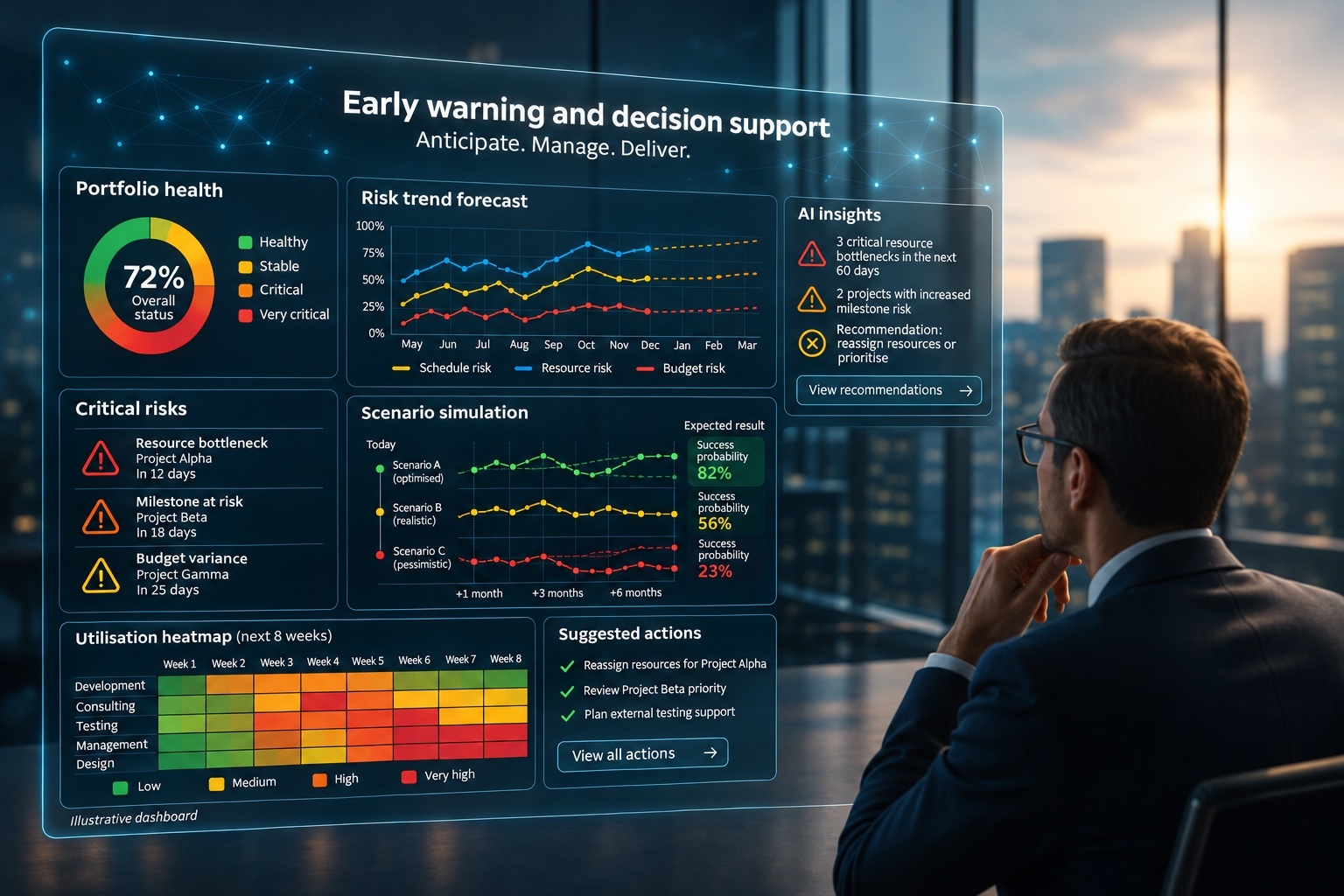
Many systems flag every overload as a problem. In practice, bottlenecks vary in significance. Some are far in the future; others immediately affect critical project phases. Effective AI should prioritise risks.
Which contextual factors matter?
Timing
Project priority
Dependencies
Milestones
Duration of the bottleneck
Effects on other projects
Effects on other people, such as colleagues waiting for the overloaded person's work
These factors support a realistic assessment of urgency.
3. Does the software support portfolio and multi-project management?
Why isolated project planning reaches its limits
Many tools work well for individual projects but become less informative when several projects run in parallel. Yet this is where major risks arise: competing resource demands, overlapping priorities and recurring skill shortages.
Why a portfolio view is essential
AI's strategic value depends on analysing resources, dependencies and bottlenecks across projects. Businesses should check whether software supports resource management across the portfolio, assesses resource conflicts together and helps prioritise work across concurrent projects.
Without this perspective, resource planning often remains reactive and limited to individual projects.
4. Can AI assessments be evaluated, or is the system a black box?
Why transparency matters
The more AI influences decisions, the more important it becomes to understand its outputs. Project leaders need to assess why a risk is considered critical or a recommendation is made. A black-box approach often creates distrust, particularly in regulated or complex project environments.
What to look for
The way neural networks work means it is not always possible to trace every detail behind a particular assessment. Testing results against familiar real-world situations is therefore especially important.
During selection, simulate a real project situation or one that has already been assessed. Experienced project leaders should first judge its severity and identify appropriate actions. Then check whether the AI produces a comparable risk assessment and a plausible recommendation.
The system's assessment does not need to match the human judgement exactly. Its direction, priorities and scale should, however, be credible to experienced practitioners. Recommendations should also be reviewed, simulated and approved by people before being incorporated into plans.
5. Does the software support strategic workforce and capacity planning?
Why operational planning is not enough
Project management extends beyond current utilisation. Many bottlenecks develop structurally over time. Businesses need systems that connect operational planning with strategic capacity management.
Relevant capabilities
Useful features include heatmaps of skill shortages, long-term capacity forecasts, analysis of recurring role bottlenecks and data-based insights for employee development. These connect project management more closely with organisational development.
6. Can AI be integrated effectively into existing processes?
Why technology alone is not a solution
Even powerful AI features create little value if they do not fit existing processes or enable a better way of working. Businesses should examine how the software integrates with their working practices.
Roles and permissions, approval processes, reporting methods and integration with existing systems are particularly relevant. Even the best AI delivers little value if the organisation does not adopt it.
7. Does the software improve decisions as well as dashboards?
Why visualisation is not the same as management
Many systems offer impressive dashboards with limited practical relevance. What matters is whether they lead to action. Vendors should be able to explain how to interpret the data, distinguish causes from effects and show what a chart helps the user decide.
Good AI project management software helps organisations identify risks earlier, set clearer priorities, plan resources more realistically and make better-informed decisions.
Conclusion: choose the AI that is most useful
Marketing terminology and spectacular individual features should not determine the choice of AI project management software. What matters is whether it addresses real project challenges and improves decisions.
Go beyond asking “Does the software have AI?” Ask: “Does the AI help us assess risks realistically, plan resources reliably and identify strategic bottlenecks early?”
In complex project environments, competitive advantage comes from better management. Organisations that assess capacity, skills, priorities and risks early and in context can make more dependable decisions across portfolios, projects and daily operations.
The most useful AI reduces project leaders' workload, creates transparency and makes uncertainty easier to manage.
Illustrative dashboard, not a screenshot of the Can Do product. Open the image to view it full size.
Free English whitepaper: Artificial Intelligence in Project Management
Explore why AI is useful in project management, how it supports project planning, where its limits lie and how it works alongside hybrid project management.
The essay by Thomas Schlereth and Michael Fenske provides background for project managers, PMOs and resource managers who want to understand the approach behind Can Do's AI.
Can Do in practice: how AI improves project management
AI-supported portfolio, project and resource management helps teams plan ahead, make decisions based on facts and reduce administrative work.
Can Do illustrates this approach. AI is integrated into analysis, assessment and management across portfolios, projects and resources.
It continually analyses projects, resources, risks and trends to support dependable decisions even when planning assumptions are uncertain. The focus is on stabilising projects and improving management rather than on individual automated tasks.
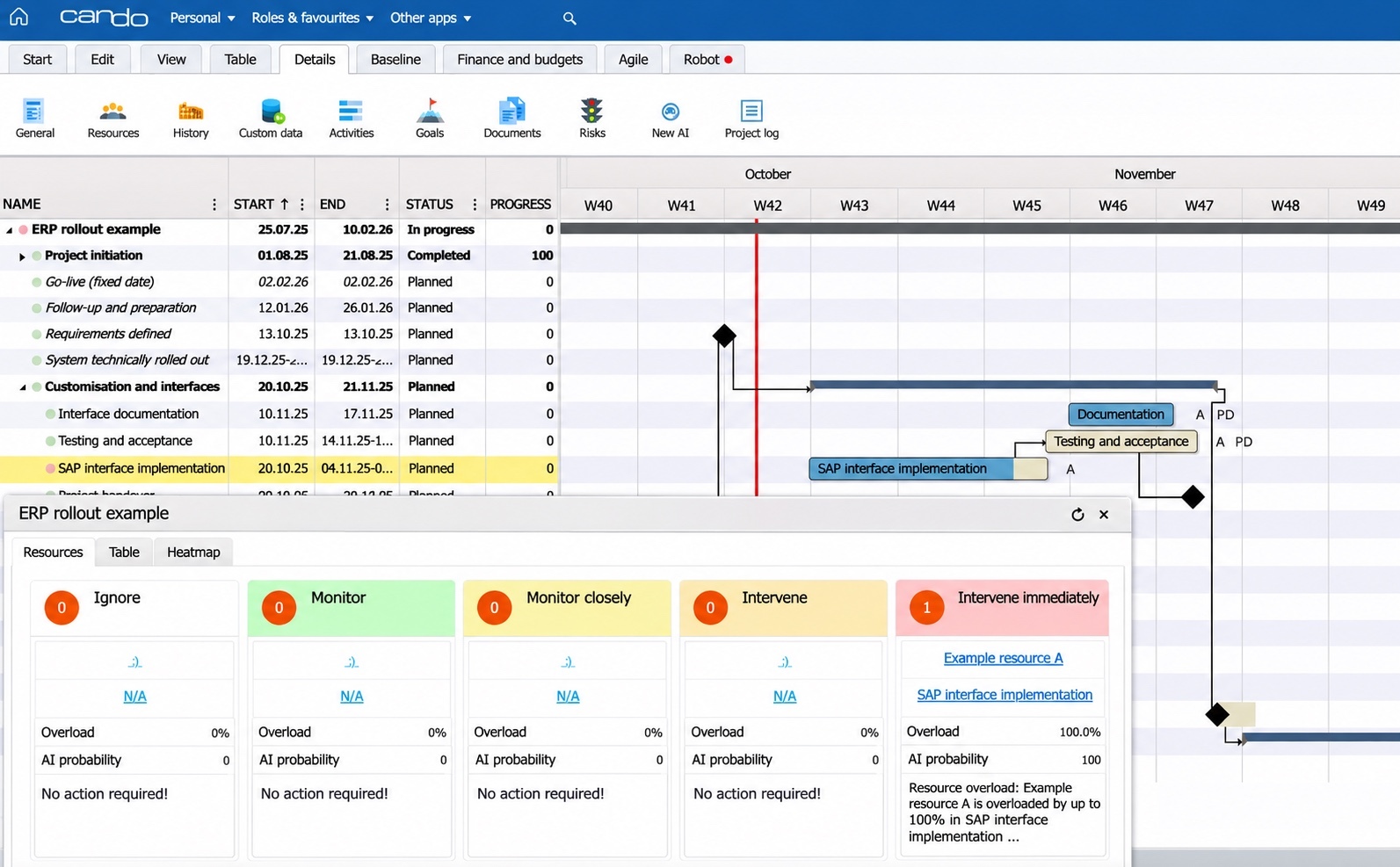
English-localised illustration based on the original Can Do screenshot; neutral sample labels. Open the image to view it full size.
Can Do's AI capabilities at a glance
AI-supported portfolio simulation using uncertain estimates
Probabilistic forecasts for dates, duration and risks
Automatic identification of critical resource risks
Real-time risk analysis when plans change
AI-based suggestions for alternative resources based on skills
Pattern recognition and trend forecasts that look ahead as well as back
AI-supported portfolio simulation with uncertain estimates
Modern AI systems can work with incomplete or uncertain planning information. In Can Do, start dates, durations and effort can be entered as estimates, such as Q3 2026 or 10 to 20 person-days of work. AI calculates scenarios with different probabilities and assesses capacity bottlenecks, schedule risks and competing objectives early.
This gives businesses a more realistic view of feasibility and the effects of new initiatives on existing portfolios before projects are approved.
AI-supported resource planning at skill level
Can Do's AI considers skills, experience and availability, enabling alternative team configurations to be simulated and realistic replacement resources to be suggested. This can substantially reduce manual coordination when resources are scarce or someone becomes unavailable at short notice.
Early warnings for proactive management
Continuous risk analysis is another focus. AI evaluates changes such as sickness absence, rescheduling or increased effort in real time and prioritises risks by significance. It distinguishes tolerable variances from urgent risks, such as threatened milestones.
AI-supported heatmaps and BI dashboards reveal patterns, trends and recurring skill or role shortages. This creates a strategic view of projects and portfolios alongside operational status information.
Video: AI as an early warning system. An English version of the source video is not currently available.
Further reading: “Introducing Can Do BI: The Future of Your Data Analysis”.
AI as integrated decision support
Can Do's AI continually supports planning, analysis and management while project leaders retain responsibility. The aim is better decisions with less coordination and reporting work.
Measurable value for your business
Project managers save up to 50% of their administrative time
Project team members save up to 15% through reduced coordination
An average of 30% less coordination work for project and line managers
Better information quality with less maintenance
More stable projects despite limited resources
Learn more about the Can Do platform and its AI capabilities.
Frequently asked questions about AI project management software
Which AI features matter most in project management software?
The most useful features assess risks, capacity, skills and dependencies. AI is especially valuable when it helps project leaders make better decisions as well as automating tasks.
Why is traditional project management software often no longer enough?
Traditional software often records tasks, dates and responsibilities. In complex environments, these are insufficient when resources are scarce, teams work across projects and skill shortages need to be identified early.
How should AI influence the choice of project management software?
AI is most useful when it prioritises risks, identifies bottlenecks and supports capacity decisions. Businesses should examine whether it provides meaningful management support or simply adds basic automation.
Why is role- and skills-based planning important?
It identifies the capabilities a project needs independently of which individual will later be available. Businesses can assess projects realistically at an earlier stage and identify structural skill gaps.
What role does AI play in capacity planning?
AI can assess capacity bottlenecks in context as well as calculate them. It helps determine whether a bottleneck is critical, needs monitoring or requires immediate action.
Why are heatmaps useful for project portfolios?
Heatmaps show which skills, roles or resources repeatedly cause bottlenecks across projects. They reveal structural risks that are often hidden within individual projects.
What should businesses look for in project management AI?
Look for explainable assessments, data quality, portfolio capabilities, skill visibility, integration and practical decision support. AI should provide insights that help people manage projects.
Is project management AI mainly relevant to large businesses?
AI is particularly valuable where there are many concurrent projects, multiple locations, limited resources or complex skill requirements. Its value grows with the complexity of the project environment.
Can AI replace project managers?
No. AI supports project leaders through analysis, prioritisation and risk assessment. People remain responsible for decisions.
What is the most important selection criterion?
The most important criterion is whether AI improves real decisions. A good solution helps organisations assess risks realistically, manage resources effectively and create dependable project plans.


 Editorial Team
 Ariane Becker : 06.11.2026