Why decision quality is becoming a differentiator in project delivery
Project delivery is uncertain by nature. Requirements change, markets move faster, resources are limited and skilled professionals remain in short supply. At the same time, expectations of reliability are rising. Deadlines must be met, budgets respected and commitments dependable.
In this environment, competitive advantage depends on the ability to assess uncertainty systematically as well as on efficiency. Businesses that can prioritise risks, rather than simply identify them, gain a structural advantage.
Artificial intelligence can help by adding an analytical perspective to decisions while project leaders retain responsibility.
AI in project delivery: beyond automation
Why capacity calculations alone are not enough
Many organisations already have precise planning data. Resource utilisation is visible, dependencies are documented and forecasts are calculated. Yet projects still come under pressure. The problem is rarely a lack of data; it is how that data is interpreted.
A calculated overload is not automatically critical, and not every delay is strategically significant. Without context, organisations risk either overreacting to alerts or overlooking genuine threats.
How assessing context creates competitive advantage
AI's real value therefore lies in analysing context. It matters not only whether a bottleneck exists, but also:
How soon it will occur
Who is waiting for the results
The current state of the project
Whether resource overload could indirectly harm other projects
Whether a delay affects a milestone
Whether there are dependencies on other projects
How long the overload lasts
The project's priority within the portfolio
Together, these factors provide a realistic picture of urgency. Organisations that prioritise risks in context can respond more precisely and make better-informed decisions.
AI can quickly analyse these complex relationships and provide an assessment: can the issue be left alone, or does it require immediate action?
Skill and role shortages as a strategic competitive factor
Why skills become the constraint
Project delivery depends on expertise as well as capacity. Missing or insufficiently available skills often affect project outcomes more severely than a shortage of hours alone.
Organisations that plan exclusively with named individuals often recognise structural skill gaps too late. Planning with roles and skills creates greater transparency and flexibility.
Turning individual problems into structural insights
An occasional skill shortage is normal. It becomes critical when the same capabilities repeatedly become bottlenecks. These patterns often remain hidden in day-to-day operations.
Aggregated analysis, at portfolio level for example, makes recurring shortages visible. Organisations can then take strategic action through targeted training, revised role profiles, external support or a sustained increase in capacity.
Sometimes only a few people in the organisation have essential skills. Pattern analysis reveals this concentration, enabling targeted training to reduce the risk. Less dependence on individual people creates flexibility.
Competitive advantage comes from turning operational symptoms into strategic insight.
From individual projects to a portfolio perspective
Why managing projects in isolation is not enough
Many organisations optimise each project separately. Yet bottlenecks often span multiple projects. When several projects need similar skills at the same time, risks accumulate.
AI-supported portfolio analysis helps identify these relationships early. The focus shifts from individual projects to patterns across the organisation.
How heatmaps support strategic decisions
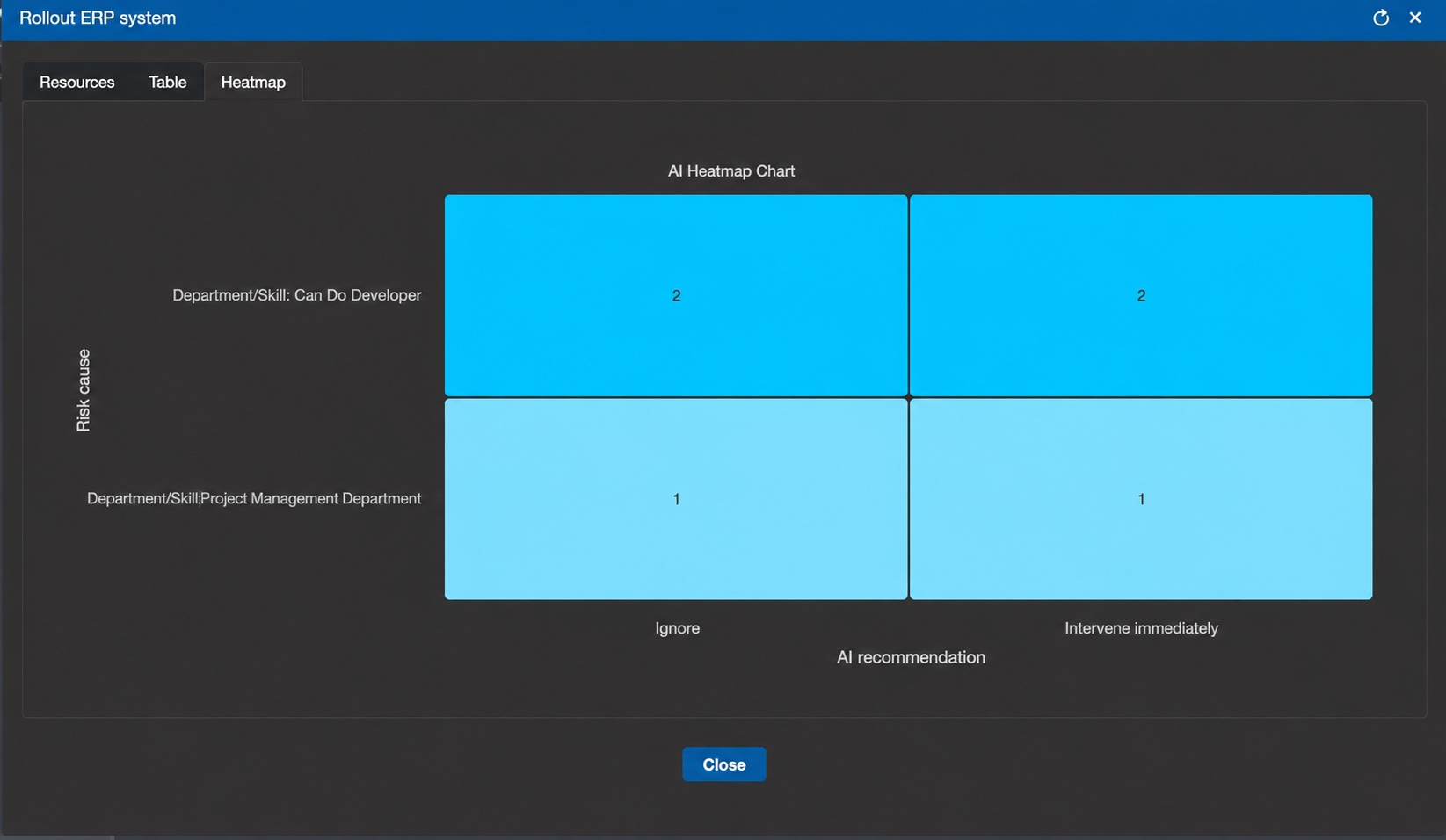
Visual analysis such as heatmaps can aggregate and prioritise bottlenecks. They show which roles or combinations of skills repeatedly become critical across projects.
This perspective is particularly relevant to PMOs, HR teams and senior management. Recruitment, training and strategic priorities can be based on reliable data.
English-localised illustration based on the original Can Do screenshot. Open the image to view it full size.
A competitive advantage from proposal to delivery
Why reliability matters to customers
The proposal stage often determines who wins the work. Committing to realistic dates and capacity builds trust and reduces the risk of escalation later.
AI-supported risk analysis helps organisations assess, before a project starts, whether they can realistically deliver the planned work with their existing skills and capacity.
How better assessments lead to dependable commitments
Businesses that assess risks in context and recognise structural shortages make more reliable commitments. Competitive advantage comes from realistic planning rather than aggressive assumptions.
Practical example: AI assessment in modern platforms
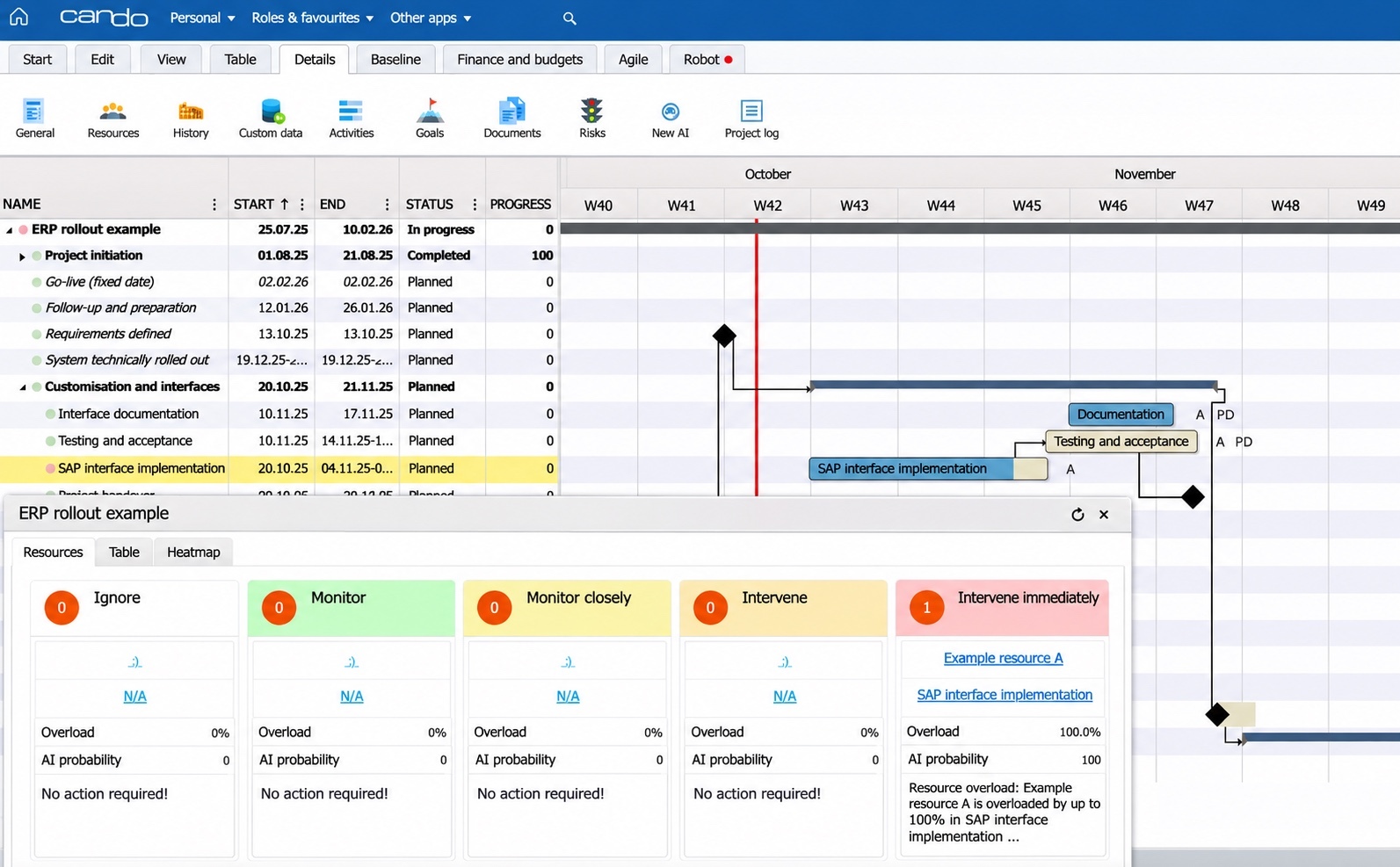
Modern project management platforms increasingly integrate AI as an additional layer of analysis. One example is Can Do, an all-in-one platform for portfolio, project and resource management. It analyses and prioritises capacity and skill risks in context. Aggregated portfolio analysis complements this assessment by revealing structural bottlenecks.
English-localised illustration based on the original Can Do screenshot; neutral sample labels. Open the image to view it full size.
Conclusion: assess uncertainty to make better decisions
Project delivery is not becoming easier, but businesses can learn to manage uncertainty more effectively.
Organisations gain a lasting competitive advantage when they prioritise risks as well as measuring them, analyse the underlying causes of bottlenecks as well as identifying them, and manage capacity strategically as well as planning it.
AI is a tool for improving decision quality, rather than an end in itself. That is where market differentiation emerges.
Free English whitepaper: Artificial Intelligence in Project Management
Explore why AI is useful in project management, how it supports project planning, where its limits lie and how it works alongside hybrid project management.
The essay by Thomas Schlereth and Michael Fenske provides background for project managers, PMOs and resource managers who want to understand the approach behind Can Do's AI.
Frequently asked questions about AI in project delivery
How does AI create a competitive advantage in project delivery?
AI creates a competitive advantage by assessing risks and bottlenecks in context, rather than simply calculating them. Prioritising capacity and skill risks helps businesses make better-informed decisions, commit to realistic dates and manage projects more reliably. The benefit comes from better decision quality as well as automation.
How does AI help assess capacity bottlenecks?
AI analyses capacity bottlenecks alongside factors such as timing, project priority, dependencies and milestones. This shows whether a bottleneck is immediately critical or can be monitored. Project leaders can respond appropriately rather than treating every issue in the same way.
Why are skill and role analyses strategically more useful than individual utilisation figures alone?
Project delivery depends on available expertise as well as available hours. Skill and role analyses show whether the right capabilities are available in sufficient depth. Recurring shortages may indicate structural skill gaps that call for training or recruitment.
How do heatmaps help analyse project portfolios?
Heatmaps provide an aggregated view of bottlenecks across projects. They show which skills or roles repeatedly become critical and where risks accumulate. This supports portfolio management, workforce planning and strategic capacity decisions.
Can AI replace project managers?
No. AI does not replace accountability for projects. It supports decisions by prioritising risks and revealing patterns. Strategic decisions remain with managers and project leaders. The value comes from combining human experience with data-based assessment.
AI-supported portfolio, project and resource management
Plan ahead, make decisions based on facts and reduce administrative work.
Can Do: the all-in-one platform for portfolio, project and resource management
Improve project, resource and risk management with Can Do, trusted by leading German businesses:
Automate skill and resource management with advanced AI tools.
Keep track of portfolios and projects through real-time visualisations.
Make better decisions with comprehensive risk assessments and business intelligence.
Can Do is developed in Germany, hosted in German data centres and fully GDPR-compliant.
Learn more about Can Do's AI capabilities.
Book a free demo to experience Can Do in 30–45 minutes and discuss your questions with our experts.
A short introduction to Can Do offers a two-minute overview of features, benefits and use cases. An English version of the original video is not currently available.
Ariane Becker is in continual exchange with interested parties from various industries. Her main focus is to bring the right information and suitable experts together and getting directly involved in the use cases and the software.


 Ariane Becker : 06.11.2026
