Artificial Intelligence (AI) is one of the most fascinating aspects of digitalization. More and more programs, apps, and networks are using AI’s ability to learn on its own and make autonomous decisions. So is AI just for programmers and geeks? We’ll put it to the test in everyday life for you.
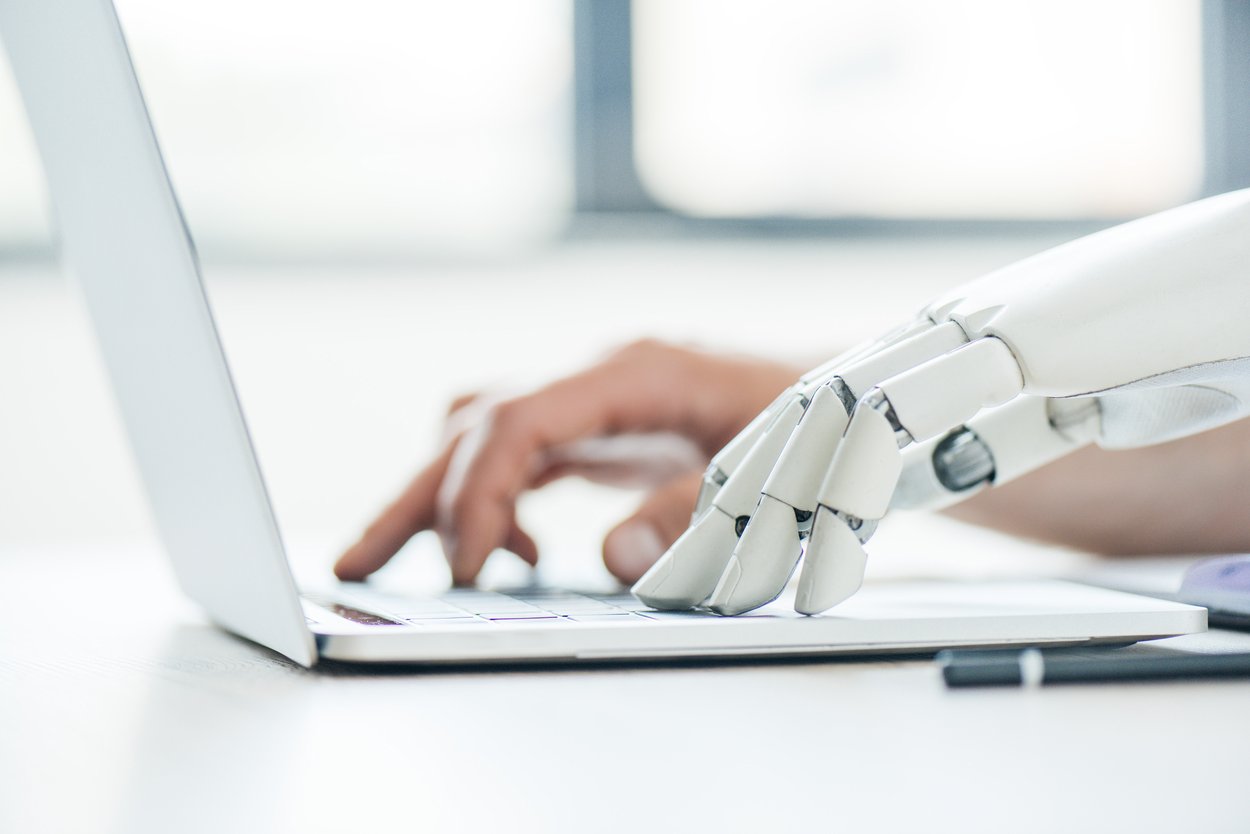
Do you still remember “cyberspace”? The term first gained widespread attention back when the internet was primarily a playground for computer nerds. People tried to make something intangible like the web a bit more tangible by giving it a fancy name straight out of science fiction. Of course, such a workaround is no longer necessary: the web has long been part of everyday life.
Once known as “cyberspace,”
today: Artificial Intelligence
The situation is very similar today with AI, or artificial intelligence. If you want to describe the interplay of well-designed algorithms, machine learning (ML), and robust data as succinctly as possible, you use the term that’s as trendy today as “cyberspace” was back then: artificial intelligence, or AI for short.
And just like cyberspace, there’s something unfathomable, almost mysterious, about it. In any case, AI seems to be something that only people who are knee-deep in code and algorithms every day can master. Or is it?
“AI” Isn’t Always AI
Artificial intelligence has long since shed its supervillain image from science fiction (another parallel to cyberspace, by the way) and has become so trendy that marketers sometimes slap the label “AI” on products that contain no artificial intelligence at all.
Often, all it takes are the right algorithms that can draw on the appropriate data. And just like that—for example, with product recommendations in online shopping —quite astonishing things happen. But they aren’t always intelligent.
But because the term “artificial intelligence” isn’t clearly defined, we encounter it more often than we actually have to do with AI. Our article“What AI Can Already Do Today” will help you tell the difference.
Artificial Intelligence Already Shapes Our Everyday Lives
A great deal of “real” AI is already firmly integrated into our daily lives and professional world, making its own decisions based on the situation. Here are a few examples:
- Search engines rely on AI to make search results more user-friendly. At Google, the artificial intelligence—which relies on artificial neural networks and natural language processing (NLP)—even has a name: BERT (Bidirectional Encoder Representations from Transformers).
- AI improves smart home technology by learning residents’ preferences and behaviors and acting accordingly.
- Artificial intelligence optimizes routing in warehousing and production.
- The project management software Can Do has also been relying on artificial intelligence for some time to enable better, smarter resource management.
Artificial Intelligence:
Easy to use when done right
Everyday examples show that the positive effects of artificial intelligence are most noticeable and tangible when the AI operates as unobtrusively as possible in the background. In everyday applications, this is important for user-friendliness anyway. This also applies when you, as a user, employ a software tool that uses AI—for example, in project management.
Artificial Intelligence is hungry: feed it!
Artificial intelligence is designed to mimic human cognitive abilities. And just like humans, AI benefits from lifelong learning. The more an artificial intelligence “learns”—that is, the more usable data it is provided with—the more well-founded and meaningful the decisions it makes will be.
Artificial intelligence is always equipped with the ability to learn automatically. Certain basic data is usually available from the start; everything else is learned step by step.
For you as a user of software like Can Do, this means: The more information you provide to the AI and the more you challenge it in your daily work, the better it becomes. It was important to us to design Can Do’s AI so that“feeding” it information isn’t a separate task, but simply happens naturally as part of your daily work.
The more you use Can Do for your project and resource management, the smarter the Can Do AI becomes. For us, this is the ideal vision of artificial intelligence: it’s simply there, supporting you a little more each day.
Conclusion: Artificial intelligence doesn’t require IT—just a little time
To return to our original question: IT professionals and programmers are, in a sense, the midwives of AI. They program it, equip it with the ability to learn, and provide it with the basic data it needs to start functioning.
Everything else, however, is in your hands as the user: A well-designed AI, as part of a software tool, independently extracts the data relevant to it from your daily routine, your tasks, and your requirements, thereby building a constantly growing information base to support the assistance it offers you.
This type of AI support—as implemented in Can Do’s resource management—optimizes itself the longer and more frequently you use the software.



 Michael Fenske : 19.11.2026
