Artificial intelligence is changing project management: it analyses project data, identifies risks and prepares status information faster. For many Project Management Offices, this raises a fundamental question.
If AI takes on more and more tasks, will the PMO still be needed?
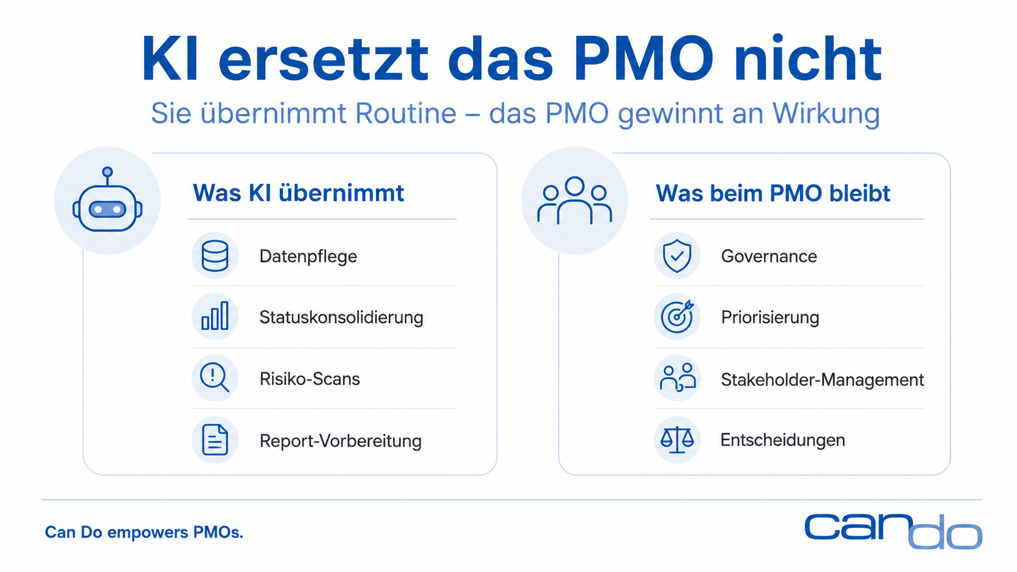
The short answer is no: AI will not replace the PMO. It primarily takes over repetitive tasks such as checking data, preparing status information and identifying risks. Prioritisation, governance, stakeholder management and accountability for decisions remain human responsibilities. For PMOs, AI therefore means less administration and more strategic management.
The future belongs to the smart PMO: one that uses AI to focus more closely on governance, prioritisation, decision support and the management of the entire project portfolio.
Will AI replace the PMO?
AI replaces individual activities, rather than the PMO's role as a whole. Recurring, data-intensive tasks are particularly suitable, including collecting status information, checking variances and preparing standardised reports.
AI can identify missing project data, flag schedule and budget variances, highlight resource bottlenecks, prioritise risks and simulate the effects of changes to plans.
This provides forecasts and possible courses of action. Decisions about priorities, budgets or project cancellations remain with the people responsible. The PMO gains more time for its core management role.
For further practical examples, see “AI in Project Management: 5 Practical Use Cases for Businesses”.
Which PMO tasks can actually be automated?
Not every PMO task is equally suited to AI. Activities that are data-intensive, repetitive and governed by rules are particularly well suited to automation.
| PMO task | AI's contribution | Human responsibility |
|---|
| Status reporting | Consolidate data and prepare drafts | Validate and interpret the findings |
| Risk identification | Identify patterns, bottlenecks and variances | Assess their significance and appropriate action |
| Portfolio planning | Simulate scenarios and their effects | Set strategic priorities |
| Resource planning | Identify conflicts and suitable alternatives | Resolve competing objectives |
| Governance | Monitor compliance with rules and data quality | Define standards and accountability |
Collecting and maintaining data
In many organisations, the PMO spends a significant proportion of its time collecting information from projects.
Project managers need reminders to provide updates. Status information is missing. Effort data is updated late. Different versions of Excel files have to be reconciled and consolidated manually.
AI-supported systems can help by:
- detecting missing entries;
- flagging inconsistent data;
- highlighting unusual changes;
- prioritising the information that needs updating;
- alerting the relevant people to outstanding issues.
The PMO no longer has to search for every piece of information manually. It can concentrate on cases that genuinely require clarification or action.
Reporting and preparing status information
Project and portfolio reporting also often follows highly standardised processes.
Data is exported, tables are adjusted, charts are updated and management presentations are prepared. This work does not automatically lead to better decisions. Initially, it simply consumes capacity.
AI and business intelligence can automatically consolidate relevant information and present it in appropriate views. The PMO then validates the findings, adds organisational context and identifies the right questions for management or the steering committee.
Identifying variances and risks
AI can analyse large volumes of project, resource and historical data faster than a person can.
It can identify when:
- a critical milestone is at risk;
- a key resource is needed by several projects at the same time;
- similar projects have previously been delayed under comparable conditions;
- a change to one plan affects other projects;
- a structural capacity problem is developing.
The value lies in filtering out the risks that really matter from the many possible variances, rather than generating as many alerts as possible.
Which tasks require human experience and an understanding of context?
AI can identify patterns and calculate probabilities. However, it does not automatically understand every political, cultural and strategic aspect of an organisation.
These are precisely the factors that matter to a PMO.
Strategic prioritisation
A system can calculate which projects are competing for the same resources. It can simulate different scenarios and show which initiative creates the greatest risks under particular assumptions.
Final prioritisation decisions, however, require more than data.
The PMO needs to consider, for example:
- which projects are particularly important to the company's strategy;
- what commitments have been made to customers or the market;
- which regulatory requirements must be met;
- which dependencies are politically or organisationally sensitive;
- which decisions management has already made;
- what postponing a project would mean for employees or customers.
These judgements cannot be fully automated.
Stakeholder management
Managing projects always involves managing relationships. A PMO needs to reconcile different interests, make conflicts visible, prepare decisions and ensure that everyone involved develops a shared understanding of the situation.
AI can provide information for a difficult conversation. It cannot conduct that conversation on the PMO's behalf.
It cannot build trust or adequately interpret resistance. It cannot reliably recognise when a recommendation that is factually sound is impractical within the organisation or needs to be communicated differently.
Governance and accountability
The PMO's core role extends beyond providing data. It establishes structures, rules and transparency across the project organisation. These include:
- decision-making bodies and escalation paths;
- planning and reporting standards;
- roles and responsibilities;
- criteria for project approval;
- prioritisation rules;
- data quality requirements;
- oversight of AI use.
Software can support this governance. People must remain accountable for it.
Why AI primarily changes administrative work
Today's debate about AI in project management often focuses on dramatic visions of the future. In practice, the greatest benefits usually begin somewhere less spectacular: reducing administrative work.
Many PMOs face a difficult situation. They are expected to enable strategic management, yet spend much of their time:
- following up;
- consolidating;
- checking;
- formatting;
- updating;
- summarising.
This creates an organisational paradox: the PMO has the best insight into what is happening across projects, but too little time to use that insight strategically.
AI can change this balance.
When data is checked automatically, risks are identified early and reports are largely prepared in advance, the PMO gains time for the tasks that require human experience.
From reporting centre to strategic management partner
Many organisations still see their PMO primarily as a reporting function. It collects status information, prepares management summaries and ensures that processes are followed.
These tasks remain important, but they should not define the PMO's entire role. An AI-supported PMO can focus more closely on questions such as:
- Are we delivering the right projects?
- Do we have enough capacity for the initiatives we are planning?
- Where are competing objectives putting delivery at risk?
- Which projects should be postponed, adjusted or stopped?
- Which critical skills will be in short supply?
- Which risks affect the entire portfolio rather than just one project?
- What decision does management need to make now?
The focus shifts from documenting activity to managing delivery.
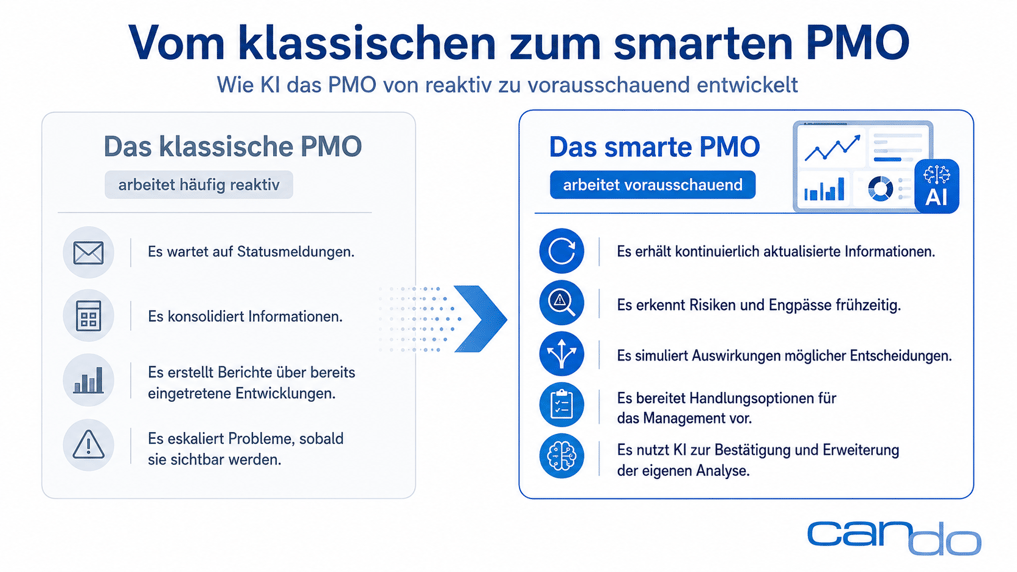
The PMO becomes more closely involved in the organisation's strategic decisions.
For a closer look at this topic, Thomas Schlereth, Managing Director of Can Do, explains how AI is changing the PMO's role in his article “The PMO Is Becoming More Important, Not Obsolete”, drawing on recent research findings.
Download the full article free of charge (PDF).
Human oversight: people remain in control
Using AI in the PMO must not lead to decisions being delegated to a system without critical review. Article 14 of the EU AI Act also requires effective human oversight for high-risk AI. For PMOs, this principle is a useful guideline regardless of the formal risk classification.
AI outputs always depend on the available data, the models used and the underlying assumptions. A recommendation can be mathematically plausible while still overlooking important organisational factors. A smart PMO therefore needs clear oversight mechanisms.
AI supports the process; the PMO makes the decisions
A practical process might look like this:
- AI analyses project, resource and risk data.
- It identifies an anomaly or a likely problem.
- The system presents possible causes and courses of action.
- The PMO checks data quality, context and consequences.
- The people responsible make the decision.
- The effects continue to be monitored.
AI serves as a tool for analysis and validation. It can complement the PMO's judgement, reveal alternatives and highlight relationships that may have been overlooked.
Decision-making authority remains with people.
How AI strengthens the PMO's role
AI is particularly valuable to a PMO when it improves the quality of management, rather than simply producing existing reports faster.
An effective PMO can use AI to:
- oversee more projects while maintaining consistent quality;
- respond to risks faster;
- prepare better-informed prioritisation decisions;
- support discussions with more objective data;
- plan resources more realistically;
- test management decisions against different scenarios;
- increase its strategic relevance within the company.
This also changes how the PMO is perceived. A team that reminds project managers to maintain their data becomes a function that shows leaders which decisions are needed to turn strategy into delivery.
What PMOs should do now: four steps to an AI pilot
PMOs should not automate every existing process without first reviewing it. A clearly defined pilot with measurable benefits is a more useful starting point.
- Select use cases: identify one or two repetitive, time-consuming tasks, such as checking whether data is up to date or preparing regular status reports.
- Establish a baseline: record the time spent, turnaround times, revision cycles and data quality before the pilot.
- Define responsibilities: agree clear data requirements, human approval points and escalation paths.
- Evaluate results: measure time savings, quality, false alarms and acceptance after the pilot, then decide whether to expand its scope.
This creates a deliberately designed working relationship between people and AI, with clear control over automation.
How Can Do strengthens PMOs
This is where Can Do comes in.
The article “Benefits for the Project Management Office” explores the wider advantages of a central PMO platform.
The software is designed to help PMOs work faster, make better-informed decisions and act more proactively. It reduces recurring analysis and reporting tasks while the PMO retains control over priorities, actions and decisions.
Can Do's AI capabilities help to:
- identify project and resource risks early;
- assess the effects of changes to plans in real time;
- highlight bottlenecks across multiple projects;
- suggest alternative resources based on skills and availability;
- simulate different project and planning scenarios;
- identify patterns and trends in large volumes of data;
- provide management information faster through dashboards.
Example: a resource bottleneck in the project portfolio
A key resource is needed by three priority projects at the same time. Can Do identifies the conflict, simulates the effects of rescheduling and shows available alternatives with suitable skills. The PMO then evaluates which scenario fits the company's strategy and existing commitments. The article “Resource Planning Software” explains the underlying approach in more detail.
Can Do's support for proactive management is particularly relevant to PMOs. Risks, capacity problems and competing objectives can become visible before they develop into urgent project issues. The PMO gains an additional perspective based on data, rather than a ready-made decision to accept without review. AI can validate judgements, highlight alternative scenarios and reveal relationships that are easily overlooked in complex project environments.
Accountability remains with the PMO.
Can Do provides a foundation for a smart PMO: less time spent on manual data maintenance, status consolidation and recurring analysis; more time for governance, prioritisation, stakeholder management and strategic project management.
Explore Can Do in the context of your own PMO
The extent to which Can Do reduces the workload depends on your project environment, the available data and your current PMO processes. The best way to assess its value is therefore to use a specific planning situation.
A Can Do demo can show, for example:
- how resource bottlenecks become visible in your project portfolio;
- how changes to plans affect other projects;
- which risks AI identifies as particularly critical;
- which alternative resources or scenarios are suggested;
- how the PMO reviews the results and uses them in its decisions.
Can Do gives the PMO better data, more time to act and a stronger basis for decisions, while retaining the value of its expertise.
Discover in a personalised demo how Can Do supports your PMO with AI and reduces administrative work.
Book your personalised demo.
Conclusion: AI changes the PMO's focus
Asking whether AI will replace the PMO is too narrow a question. AI will change many administrative tasks. It will analyse data faster, identify risks earlier and prepare reports more efficiently. This creates a significant opportunity.
The PMO can move away from activities that currently take up a great deal of time while creating limited strategic value. At the same time, governance, prioritisation, stakeholder management and decision support become more important.
The future needs stronger PMOs that use AI confidently, assess its outputs critically and turn them into better decisions for the entire project organisation.
Can Do helps PMOs continuously analyse project, resource and risk data, identify bottlenecks early and evaluate different planning scenarios. The PMO retains accountability. The software reduces administrative work and provides the information PMOs need to act faster, more proactively and more strategically. To see how this works in your own project environment, you can explore Can Do using a specific planning situation.
Would you like to share this topic internally? The full article is available as a free PDF, with no registration required.
Download the full article (PDF).
Frequently asked questions about AI and the PMO
Will artificial intelligence replace the PMO?
No. AI can primarily take over repetitive, administrative and data-intensive tasks. Strategic prioritisation, governance, stakeholder management and accountability for decisions remain PMO responsibilities.
Which PMO tasks can AI automate?
AI can check data for completeness, identify variances, prioritise risks, prepare status reports, identify resource bottlenecks and simulate the effects of changes to plans.
What is a smart PMO?
A smart PMO uses integrated data, automation and artificial intelligence to manage projects and resources more proactively. Administrative work is reduced, allowing a greater focus on governance, prioritisation and decision support.
Which tasks remain human responsibilities?
People need to set strategic priorities, assess organisational context, engage stakeholders, mediate conflicts and remain accountable for decisions.
What does human oversight mean for the PMO?
Human oversight means that AI provides analysis, alerts or recommendations, while the people responsible make the final assessment and decision. The PMO retains control and can review, interpret or reject AI outputs.
How can AI agents support a PMO?
AI agents can identify missing status information, prompt updates, summarise risks, track outstanding actions and prepare information for portfolio or steering committee meetings.
What are the benefits of AI for a PMO?
AI can reduce administrative work, improve data quality, make risks visible earlier and create more time for strategic management. This can strengthen the PMO's role as a decision-making partner for management.
How should a PMO start introducing AI?
A PMO should first identify repetitive and time-consuming processes. It should then define clear use cases, responsibilities, data requirements and human approval points. A gradual introduction is usually more appropriate than full automation.
Is the full article about PMOs and AI available as a PDF?
Yes. The full article “The PMO Is Becoming More Important, Not Obsolete” by Thomas Schlereth, Managing Director of Can Do GmbH, is available as a free PDF with no registration required.


 Ariane Becker
 Thomas Schlereth : 05.11.2026
